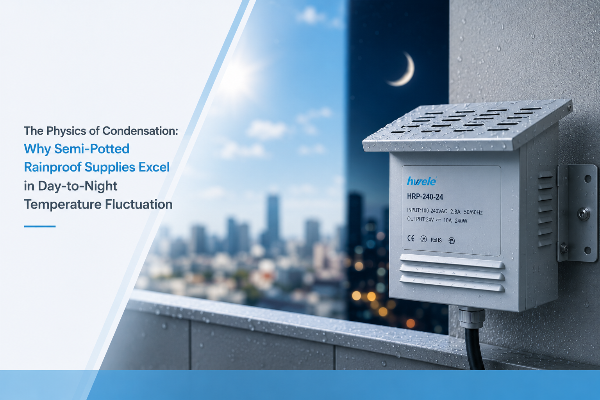


In outdoor digital signage, telecom infrastructure, and perimeter security grids, hardware enclosures are relentlessly subjected to cyclic environmental dynamics. While engineering teams routinely specify louvered baffles to deflect structural rainfall, a far more insidious, invisible threat operates at a molecular level within the cabinet atmosphere: transient condensation phase-change.
Many field hardware failures attributed to “water ingress” are not caused by external rain breaching the enclosure seals. Instead, they are entirely self-generated by the internal thermodynamics of the cabinet itself. As daytime operational heat transitions into cold night environments, the internal air mass undergoes rapid density shifts, resulting in a phenomenon known as the breathing effect. Understanding the physics behind this cycle is critical for procurement directors looking to safeguard high-capital infrastructure assets from unexpected field downtime.
To understand why moisture forms inside a vented, rain-shielded power supply, we must look at the thermodynamic relationship between relative humidity (RH), ambient air mass, and localized surface temperatures. Air holds water vapor based on its thermal state; warmer air possesses significantly higher vapor capacity than colder air.
During peak daylight hours, high-efficiency switching power modules and peripheral components run continuously, raising the internal temperature of the cabinet. This high thermal zone expands the internal air volume, forcing a portion of it out through louvered vents. Simultaneously, any residual localized moisture within the cabinet is converted into a highly agitated gaseous vapor state.
When the sun sets, the exterior ambient temperature drops sharply. This rapid thermal drop cools the outer metallic or polycarbonate skin of the enclosure, creating a steep internal thermal gradient. The air inside the cabinet rapidly contracts, creating a slight negative localized pressure vacuum that draws humid night air in through the ventilation vents. This is the enclosure breathing effect cycle.
As this warm, moisture-laden internal air mass contacts the rapidly cooling surface of the power supply’s printed circuit board (PCB), the air layer immediately adjacent to the board drops below its critical dew point temperature. The invisible gaseous vapor undergoes an exothermic phase transition, transforming directly into liquid water droplets. This process typically manifests in one of two distinct physical states:
Historically, systems engineers had only two options to counter this day-to-night condensation lifecycle. The first was to utilize completely unpotted power modules treated with standard, thin spray-on conformal coatings—a setup that frequently fails when heavy dropwise pooling occurs. The second option was to transition to a heavy, fully encapsulated IP67 silicone-filled housing. While highly effective, full potting significantly increases material costs and relies entirely on conduction cooling, which puts strict limits on maximum wattage output.
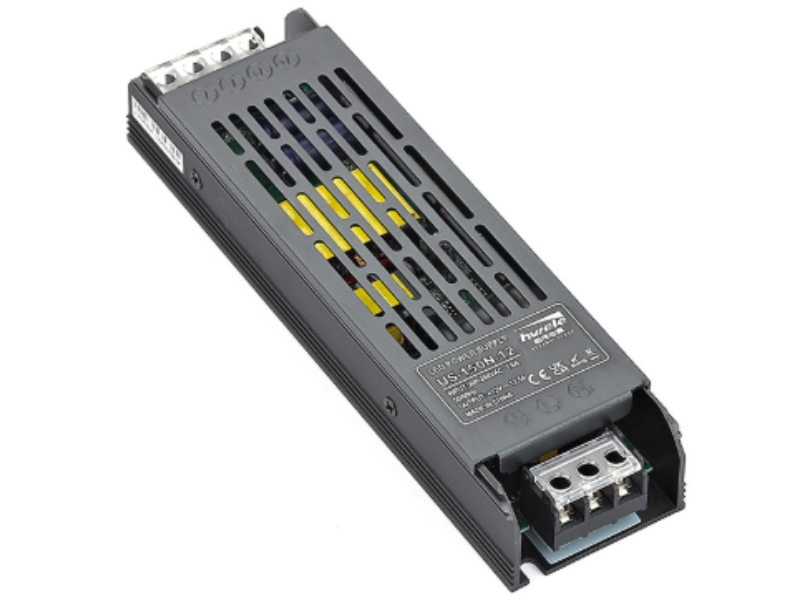
The modern, high-performance solution to this challenge is the semi-potted rainproof power supply topology. This advanced engineering method uses targeted selective insulation to optimize protection where it matters most.
The Strategic Logic of Semi-Potting Isolation:
Instead of filling the entire aluminum housing with costly thermal gel, automated factory dispensers selectively inject a precise layer of high-dielectric silicone compound across the bottom plane of the PCB assembly.This split-level topology separates components into two distinct protection zones:
- The Hermetically Sealed Zone: Low-power logic tracks, SMD resistor networks, pulse-width modulation (PWM) control ICs, and high-impedance traces are completely encased within the solid silicone layer. Even if condensation film forms on top of this layer, it cannot reach the live electrical contacts underneath.
- The Open Convection Zone: Large, high-power magnetic components—such as the primary power transformer, input choke coils, and heavy-duty smoothing electrolytic capacitors—protrude safely above the silicone plane. This layout allows them to shed heat directly into the open air via unhindered convective pathways.
By using this hybrid insulation approach, the power module gains excellent moisture protection across its most sensitive circuitry. Concurrently, it retains the rapid heat dissipation performance of an open-frame convection chassis, allowing high power capacities spanning a precise 350W to 400W matrix without requiring active, failure-prone cooling fans.
To assist procurement teams in choosing the right component specifications for their specific deployment zones, the table below breaks down the technical differences between these common moisture defense strategies:
| Engineering Attribute | Standard Conformal Spray | Hwele Semi-Potted Layout | IP67 Full Encapsulation |
|---|---|---|---|
| Protective Layer Thickness | Minimal (25–75 microns acrylic) | Robust (3–8 millimeters silicone) | Total (Complete chamber fill) |
| Dropwise Pooling Resistance | Low (Pinhole corrosion risks) | Exceptional (High dielectric barrier) | Absolute (Zero air contact) |
| Primary Cooling Mechanism | Air Convection | Hybrid (Convection + Conduction) | Pure Enclosure Conduction |
| Cost-Per-Watt Economy | Highly Inexpensive | Optimal Balance (High Value) | Premium Pricing Strategy |

Executing a reliable semi-potted design requires advanced production machinery. Manual application often introduces micro-bubbles and uneven layer thicknesses, creating structural weak points where moisture can accumulate and bypass the insulation barrier over time.
Zhejiang Hengwei Technology (Hwele) maintains complete oversight of this specialized manufacturing process within its 6,000m² automated production plant. Hwele utilizes high-precision, computer-controlled automatic gel dispensing systems to ensure perfectly level, bubble-free silicone layer distribution across its entire high-power Rainproof Power Supply line (350W–400W).
By using premium, high-elasticity silicone formulations that resist thermal expansion cracking, Hwele hardware maintains its dielectric protective seal through thousands of day-to-night temperature cycles. Backed by rigorous climate chamber burn-in protocols and key international safety certifications (CE, TUV, UL, ROHS), Hwele provides global procurement networks with highly reliable outdoor power solutions build to last.
Stop allowing day-to-night temperature shifts to compromise your outdoor display grids. Partner with a specialized factory manufacturer capable of delivering advanced semi-potted power modules engineered for harsh outdoor environments.
Q1: What exactly is the environmental “breathing effect” in outdoor control cabinets?
A: It is the natural airflow cycle caused by daily temperature changes. As internal equipment heats up during the day, the air expands and vents outward. At night, as temperatures fall, the internal air mass contracts, drawing humid exterior air back into the cabinet enclosure.
Q2: Why does dropwise condensation pose a greater danger to circuit boards than film condensation?
A: While film condensation creates a broad moisture layer, dropwise condensation forms concentrated, high-surface-tension water droplets directly on component pins. When these droplets grow large enough to bridge the tiny spacing gaps between high-voltage traces, they instantly trigger severe electrical arcing failures.
Q3: How does semi-potting maintain efficient thermal cooling without active fans?
A: The design relies on split-level positioning. Low-power, sensitive control ICs are sealed within the bottom silicone layer, while high-heat components—like the main transformer—protrude cleanly above the potting plane, allowing them to vent heat via natural air convection.
Q4: Can I replace a fully potted IP67 power supply with a semi-potted rainproof module in any environment?
A: Semi-potted modules are highly effective for standard outdoor enclosures subjected to regular rain and temperature cycling. However, for extreme applications involving complete water submersion, heavy marine salt fog, or entirely unventilated micro-enclosures, a fully encapsulated IP67 power supply remains necessary.


 Optimized by Seraphinite Accelerator