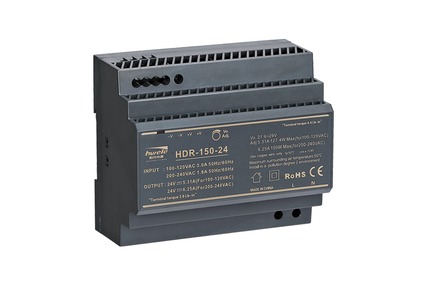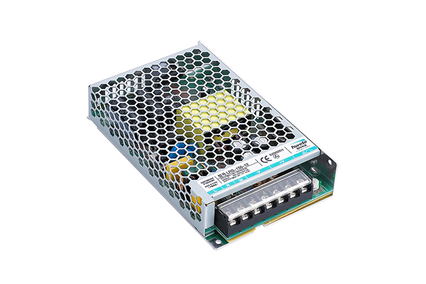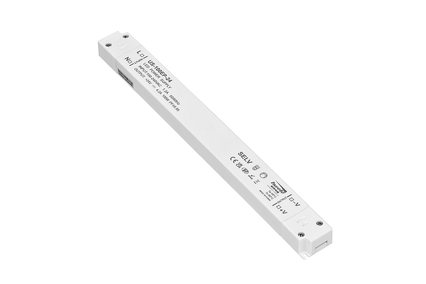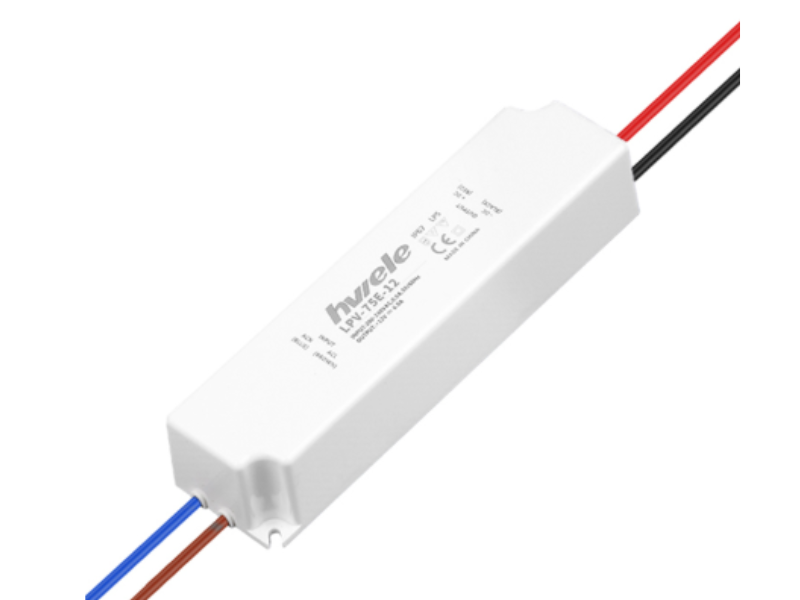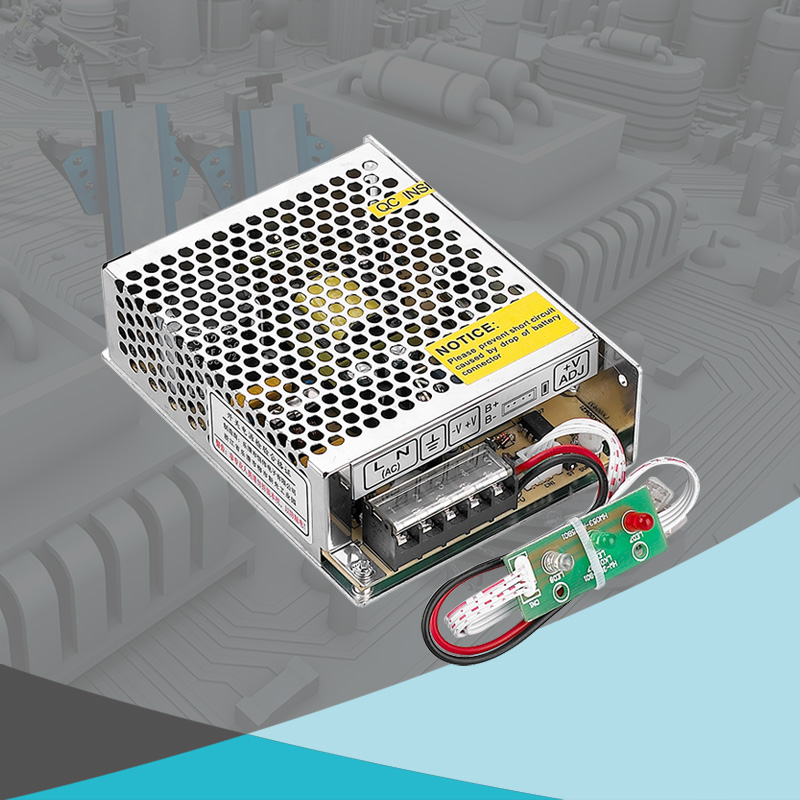


A distribution facility in a lightning-prone region of Southeast Asia loses an average of 14 enclosed power supplies per year to surge events. Each failure takes down a conveyor segment, triggers a 4-hour unplanned stoppage, and costs roughly $3,200 in lost production plus replacement. The root cause is rarely the lightning strike itself — it is the gap between what the power supply was rated to survive and what the local grid actually delivers.
Here is the uncomfortable truth most procurement teams learn too late: a power supply that passes basic safety certification is not automatically surge-immune. CE, UL, and 3C confirm the unit won’t electrocute someone or catch fire under normal conditions. They say almost nothing about whether the input stage survives a 4 kV transient coupled in from a nearby lightning strike or a 500-horsepower motor switching off across the factory floor.
This guide demystifies surge protection for industrial power supplies — what a surge actually is, the three ways it physically destroys equipment, the international standard (IEC 61000-4-5) that defines real protection levels, the components that do the protecting (MOV, TVS, GDT), the three-tier architecture that makes protection actually work in the field, and a 7-point checklist you can hand to any supplier before signing a purchase order.
A surge (or transient overvoltage) is a short-duration, high-energy voltage spike — often thousands of volts — superimposed on the normal mains voltage. For perspective: a 24 V or 48 V industrial power supply is designed around components rated for maybe 100–200 V on the input side. A 4 kV transient is 20–40× that margin. Without protection, the math is not in your favor.
There are three primary sources of surges that affect industrial power supplies:
Lightning is the most dramatic and the highest-energy source. A direct or nearby strike to a power line, pole, or building injects far more current at far higher voltage than any electronic system is rated for. Even a strike hundreds of meters away induces a transient onto nearby cabling through electromagnetic coupling. This is why outdoor installations — street lights, CCTV poles, telecom cabinets — are the highest-risk deployments for surge damage.
This is the silent killer in industrial environments. When large reactive loads — motors, capacitor banks, transformers — switch on or off, they behave like momentary short circuits (during energization) or dump stored field energy back into the line (during de-energization). Both create fast current transients that induce voltage spikes on the shared bus. In a factory with variable-frequency drives and large motors, these events happen daily, not rarely.
Component failures elsewhere in the system — an unintentional short, an open circuit, a grounding fault — can apply transient overvoltages to the power supply input. A single failed contactor upstream can cascade a transient to every PSU on the same feeder.
⚠️ Key insight: Lightning gets the headlines, but for most industrial facilities, load transients and faults cause more cumulative surge damage than lightning ever will. A PSU spec’d only for “lightning protection” but not for IEC 61000-4-5 Class 3–5 switching surges is vulnerable 99% of the time.
Understanding the failure mechanism is the fastest way to understand why protection works. A surge damages equipment through four distinct physical pathways:
Electronic components — diodes, transistors, ICs, the bridge rectifier in your PSU — have extremely thin insulation layers measured in nanometers. When surge voltage exceeds the breakdown threshold, it literally punches a hole through that insulation, creating an internal short circuit. Result: chip burnout, rectifier failure, total PSU death. This happens in microseconds.
A lightning-induced current doesn’t politely respect wire gauges. It flows through whatever path offers the least resistance — including PCB traces designed for 2 A that suddenly carry 2,000 A for a few microseconds. Joule heating follows a brutal equation:
P = I²R
Power dissipated as heat = current² × resistance
Because current is squared, a 10× current spike generates 100× the heating. Thin PCB traces vaporize. Components explode or char black. The damage is permanent and瞬间 (instantaneous).
Lightning doesn’t need to hit your equipment directly. A fast-changing magnetic field from a nearby strike induces a high voltage in any nearby cable — power, network, CCTV coax, signal lines. That induced surge travels along the wire straight into your power supply’s input or, worse, its low-voltage signaling side. This is why a surge protector on the AC line alone is insufficient if the data line is unprotected.
High voltage jumps gaps. A 4 kV transient can arc across connector pins, terminal blocks, and component leads that are perfectly safe at 230 V. The arc creates localized temperatures hot enough to burn circuit boards, melt plastic housings, and weld contacts shut.
Together, these four pathways explain why prevention is the only strategy that works — once a surge reaches the PSU internals, the damage is done before a human or a fuse can react.
Not all “surge protected” claims are equal. The international benchmark is IEC 61000-4-5, published by the International Electrotechnical Commission. It defines a standardized surge test waveform (1.2/50 µs open-circuit voltage, 8/20 µs short-circuit current) and assigns installation classes with escalating test voltages:
| Install. Class | AC Line-to-Line | AC Line-to-Ground | Typical Deployment |
|---|---|---|---|
| Class 1 | 0.5 kV | 0.5 kV | Well-protected indoor, no external exposure |
| Class 2 | 1 kV | 1 kV | General indoor commercial (minimum bar) |
| Class 3 | 2 kV | 2 kV | ✅ Industrial indoor with switching loads |
| Class 4 | 4 kV | 4 kV | ✅ Industrial + outdoor + exposed cabling |
| Class 5 | 4 kV | Depends | ✅ Heavy industrial, telecom, grid-adjacent |
For industrial power supplies, Class 3 is the practical floor and Class 4 is the recommendation for anything outdoors or near heavy machinery. If a supplier’s datasheet only claims “surge protection” without specifying an IEC 61000-4-5 class, that is a red flag — they are likely at Class 1–2 at best.
Surge protection inside a power supply relies on two circuit philosophies — clamping (limit voltage to a ceiling) and crowbar (short the line to ground) — implemented with three core components. Each has a distinct speed-vs-energy trade-off:
| Component | Surge Current Rating | Speed | Topology | Best For |
|---|---|---|---|---|
| TVS Diode | Low | ⚡ Fastest | Clamp | Fast transients, low-energy, sensitive IC protection |
| MOV (Varistor) | Medium | ⚠️ Medium | Clamp | Primary bulk protection — cost-effective, high-energy |
| GDT (Gas Discharge Tube) | High | 🐢 Slowest | Crowbar | High-current lightning, used with MOV/TVS for robustness |
💡 Design insight: A robust PSU surge-protection stage cascades all three — GDT for bulk lightning energy, MOV for medium transients, TVS for the fast tail that reaches sensitive components. A design relying on a single MOV is a single point of eventual failure.
Neither reference article presents this — and it is the single most important concept for real-world surge survival. No single protection layer is sufficient. The IEC and IEEE approach uses a coordinated, zone-by-zone defense:
| Tier | Location | Handles | Lets Through |
|---|---|---|---|
| Type 1 | Building service entrance | Direct lightning strike, 10/350 µs waveform | Reduced to ~2.5–4 kV (still dangerous) |
| Type 2 | Distribution / control panel | Switching surges, induced transients, residual from Type 1 | Reduced to ~1–2 kV |
| Type 3 | Inside the PSU (built-in) | Final residual transient — MOV/TVS/GDT stage | Clamped to safe component level (< input rating) |
Think of it like a series of sieves. Each tier catches the bulk of the energy and passes a smaller, slower remnant to the next. By the time the transient reaches the PSU’s sensitive components, it has been reduced from a 4 kV monster to a few hundred volts the input stage can absorb.
Critical coordination rule: The tiers must be energy-coordinated. A Type 1 SPD sized wrong relative to a Type 2 can itself become the failure point. This is why a “just add an SPD” approach to an existing panel often underperforms — the coordination between layers was never engineered.
Outdoor luminaires on poles are the #1 lightning-exposure scenario. A strike to the pole or adjacent power line induces a transient that travels down the supply cable directly into the driver. Combined with the long cable runs acting as antennas, street lighting experiences both direct and induced surges.
CCTV cameras and access controllers face a double threat: the AC/DC supply line and the data/coax line, both of which pick up induced surges. A surge entering via the data line can destroy the PSU’s low-voltage control side even if the AC side is protected.
Variable-frequency drives, large motors, and capacitor banks create daily switching transients on the plant bus. These are lower-energy than lightning but far more frequent — the cumulative degradation is what kills PSUs here.
Unattended cabinets fed from long rural lines experience both lightning and grid switching. High service-interrupt cost makes surge protection non-negotiable.
Most industrial power supplies use MOVs as their primary surge component because they are cheap and handle meaningful energy. But MOVs have a fatal flaw that directly connects to your total cost of ownership: they degrade a little with every surge they absorb.
Each event slightly lowers the MOV’s clamp voltage and increases its leakage current. After dozens of surges — or one large one — the MOV can shift from “protective component” to “latent short,” either failing open (silently removing protection) or failing short (creating a fire risk). The danger is that the PSU still powers on normally — you just lost your surge protection without knowing it.
💡 Procurement implication: A PSU with surge protection is not a “set and forget” asset in a high-risk zone. Factor in inspection and replacement cycles — and ask suppliers about MOV lifetime indicators or redundant protection stages. This is exactly why evaluating surge protection in isolation from lifecycle cost is a mistake; read our guide on calculating the real TCO of enclosed switching power supplies to see how surge-related failures skew the numbers.
A common specification error: assuming a PSU’s “overvoltage protection” (OVP) covers surges. They are different threats requiring different mechanisms:
| Property | Surge / Transient | Sustained Overvoltage |
|---|---|---|
| Duration | Microseconds | Seconds to minutes |
| Energy | Very high (kV, kA) | Lower, sustained |
| Mechanism | MOV / TVS / GDT clamp | OVP shutdown / crowbar |
| Example | Lightning, motor switching | Grid brownout, wrong tap |
A PSU needs both: surge protection for fast transients and OVP for sustained conditions. Confirm both are present and rated on the datasheet.
Before signing a purchase order for any industrial or outdoor power supply, send this checklist to your supplier:
At HWELE, we engineer switching power supplies and LED drivers with surge immunity designed into the input stage — not bolted on as an afterthought. Our 20+ years of switching power supply manufacturing across industrial, outdoor, and medical applications inform every protection decision.
| Specification | Details |
|---|---|
| Power Range | 10W – 480W |
| Surge Context | Industrial control panels — motor switching, capacitor bank transients |
| Recommended Rating | IEC 61000-4-5 Class 4 (4 kV) when paired with panel-level Type 2 SPD |
| Explore | NDR aluminum DIN rail power supplies → |
| Specification | Details |
|---|---|
| Power Range | 6W – 320W |
| Surge Context | Outdoor street & area lighting — direct/induced lightning, long cable runs |
| Recommended Rating | Built-in IEC 61000-4-5 immunity + external Type 1/2 SPD at feeder |
| Explore | IP67 waterproof LED drivers → |
| Specification | Details |
|---|---|
| Power Range | 10W – 600W |
| Surge Context | Factory automation, telecom cabinets, remote installations |
| Explore | Enclosed switching power supplies → |
HWELE provides OEM/ODM custom power supply solutions — including enhanced surge-immunity stages, coordinated SPD integration, and redundant protection topologies — engineered to your exact deployment environment and IEC 61000-4-5 class requirement.
20+ years of switching power supply manufacturing. CE / KC / 3C / UL certified. ISO9001 & ISO14001 quality management.
A surge protection device (SPD) is an external component installed at the panel or service entrance that diverts surge energy to ground before it reaches equipment. Built-in surge protection is component-level (MOV/TVS/GDT stages) inside the PSU that clamps any residual transient that gets through. They are complementary layers in a three-tier architecture — you need both, not one or the other.
The standard assigns installation classes 0–5 with test voltages from 0.5 kV to 4 kV, tested both line-to-line and line-to-ground using a 1.2/50 µs open-circuit voltage waveform. Industrial power supplies should target Class 3 (2 kV) as a minimum and Class 4 (4 kV) for outdoor or heavy-industrial deployments. The class defines how much surge energy the unit is verified to survive.
No single device can. A direct strike carries energy far beyond any component’s rating. Direct strikes require building-level Type 1 SPDs plus equipotential bonding — and even then, the goal is to survive the residual energy, not the strike itself. PSU internal protection is designed for induced and residual transients, not direct hits. Proper three-tier coordination is what makes survival possible.
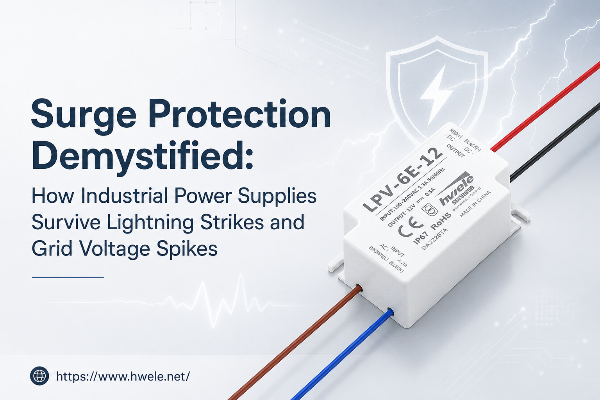
TVS diodes respond fastest (nanoseconds) but handle low energy — ideal for protecting sensitive ICs from fast transients. MOVs respond in microseconds, handle medium-high energy, and are cost-effective for bulk protection — but they degrade with every surge event. GDTs handle the highest currents but are slowest. Robust designs cascade all three so each handles what it does best.
Check the datasheet for: (1) an explicit IEC 61000-4-5 rating with installation class, (2) a surge withstand or impulse voltage specification, and (3) a description of the internal protection circuit (MOV/TVS/GDT). If the datasheet only says “surge protected” with no class or test detail, the protection is likely minimal (Class 1–2).
Yes — outdoor installations are the highest lightning-exposure scenario for drivers. IP67 waterproof LED drivers should be specified with built-in IEC 61000-4-5 immunity and paired with external Type 1/2 SPDs at the feeder or fixture. Long cable runs on outdoor lighting act as antennas for induced surges, so protection is non-negotiable for reliability.
It is a coordinated, zone-by-zone defense: Type 1 SPD at the building service entrance handles direct lightning (10/350 µs waveform); Type 2 SPD at distribution panels handles switching surges and residual from Type 1; Type 3 is the built-in protection inside the PSU that clamps the final remnant. Each tier reduces let-through voltage to safe levels for the next — no single tier is sufficient alone.
For MOV-based protection, inspection should be annual in high-risk zones (lightning-prone, heavy switching) with replacement per manufacturer guidance — typically every 3–5 years, or immediately after a major surge event. Many modern SPDs include status indicators or remote monitoring to flag degradation before failure.
A surge (transient overvoltage) is a microsecond-duration, high-energy spike from lightning or switching — handled by MOV/TVS/GDT clamps. Sustained overvoltage is a seconds-to-minutes voltage rise from grid brownouts or incorrect tap settings — handled by overvoltage protection (OVP) shutdown circuits. A robust PSU needs both; they protect against fundamentally different threats.
Yes. Load switching, capacitor banks, and faults on the grid create transients that stress PSU input stages daily in industrial settings. These cumulative events — not just rare lightning — are the leading cause of surge-related PSU failures in factories. Specifying IEC 61000-4-5 Class 3–5 immunity directly addresses this risk.
Published by HWELE — Switching Power Supply & LED Driver Manufacturer. 20+ Years of Experience. CE / KC / 3C / UL Certified.


 Optimized by Seraphinite Accelerator