

Within modern factory automation, heavy infrastructure grids, and large-scale manufacturing facilities, the power distribution architecture inside control panels dictates overall network reliability. Electrical design engineers and industrial procurement managers face a fundamental architectural choice when mapping out their system architecture: Should the primary DIN rail power supply source electrical energy from a single-phase line or a three-phase network?
This choice impacts far more than simply selecting part numbers from a catalog. It affects fundamental engineering parameters, including system balance, thermal dissipation, inrush current thresholds, and operational resilience against complete mains power loss. Selecting the incorrect phase layout can lead to grid imbalances, premature component wear, and catastrophic line dropouts.
To optimize system longevity and manage the Total Cost of Ownership (TCO) across complex enterprise portfolios, it is essential to understand the underlying thermodynamic and electrical differences between these two methodologies. This engineering analysis provides a structured technical comparison between single-phase and three-phase AC-DC industrial control setups.
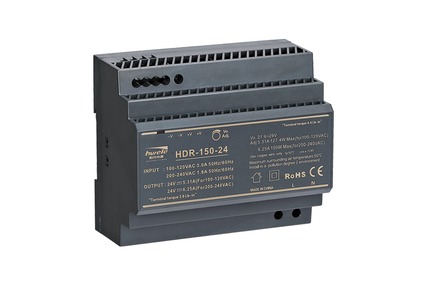
A Single-Phase DIN Rail Power Supply is typically designed for installation across standard low-voltage networks. These modules generally feature a broad universal wide-range input spanning from 85V to 264V AC, allowing seamless international deployment across standard 110V, 120V, 220V, and 240V utility lines.
Mechanically and electrically, single-phase setups are optimized for low-to-medium power demands—typically anywhere from a modest **10W to 480W**. They are the standard configuration choice for localized distribution boards, building automation systems, standalone machine tools, and remote telemetry monitoring enclosures. The primary advantage of a single-phase module lies in its simple installation parameters, relatively low up-front acquisition cost, and general utility grid accessibility.
While single-phase power supplies are versatile, drawing high current levels from a single phase within a larger multi-device automation line can destabilize the overall power distribution setup. In high-wattage scenarios, relying exclusively on single-phase loads introduces significant phase imbalances across a facility’s main electrical supply. This structural asymmetry can degrade transformer efficiency, generate parasitic harmonic feedback currents inside neutral conductors, and cause voltage fluctuations that disturb sensitive downstream peripheral instrumentation.
For enterprise settings demanding high raw power output alongside exceptional line stability, a three-phase power architecture becomes necessary. These heavy-duty industrial AC-DC converters operate on wide-range high-voltage input bands—typically ranging from 320V up to 575V AC. This allows them to effortlessly terminate across standard global 380V, 400V, and 480V three-phase grid infrastructures without requiring external buck-boost line transformers.
Three-phase power configurations are designed for heavy-duty environments, consistently delivering continuous, clean DC output capacities from **240W, 480W, and up to 960W** within ultra-compact physical footprints. They are typically deployed in heavy automotive assembly lines, chemical processing installations, continuous water treatment plants, and centralized server-rack monitoring frameworks.
The Inrush Current & Phase Advantage Explained:
Because three-phase input current is continuously drawn simultaneously across three distinct phase conductors offset by 120 electrical degrees, the incoming rectified DC waveform is naturally smoother and carries a much higher baseline frequency.This provides critical advantages for large industrial control systems:
- Drastically Lower Inrush Current: Eliminates the severe initial current spikes common to large single-phase setups, preventing nuisance tripping of input circuit breakers.
- Perfect Line Balance: Distributes the entire load evenly across all three incoming phases, maintaining grid integrity throughout the facility.
- Reduced Ripple Voltage: Delivers incredibly clean DC power downstream to sensitive logic gates and PLC modules.
The primary advantage of a premium three-phase industrial power supply is its built-in fault tolerance. High-tier industrial modules integrate a protective mechanism known as **Phase Failure Protection**. If a facility suffers a “lost phase” event due to an outdoor grid failure, vehicle accident, or fuse blowout, a standard three-phase power supply can automatically adapt. It will transition instantly into continuous **Two-Phase Mode**, allowing the automation cabinet to keep running indefinitely at reduced capacity instead of dropping line voltage and initiating an emergency facility stop.
To guide procurement workflows and simplify engineering component validation, the matrix below details the mechanical and electrical trade-offs between both power supply types:
| Engineering Parameter | Single-Phase DIN Rail PSU | Three-Phase DIN Rail PSU |
|---|---|---|
| Typical Input Voltage Range | 85V – 264V AC (Universal Single Line) | 320V – 575V AC (Wide-Range Polyphase) |
| Optimal Wattage Window | 10W to 480W | 240W to 960W+ |
| Inrush Current Magnitude | High (Requires slow-blow fuses) | Extremely Low (Smoother startup draw) |
| Mains Line Balancing | Creates asymmetric single-line loading | Maintains perfect cross-phase balance |
| Fault Tolerance & Safety | Loses all power immediately upon line fault | Supports safe two-phase operation |
| Primary Deployment Application | Localized PLCs, sensors, Building Management Systems | Heavy robotics, main processing loops, server grids |

When standardizing a supply chain component portfolio, purchasing managers should look beyond basic up-front hardware costs. Evaluating a vendor requires cross-referencing three crucial engineering and logistics factors:
If an automation panel’s aggregate continuous power demand remains under **240W**, a single-phase switching module is generally the most economical choice. However, if system loads scale upward toward **480W or 960W**, switching to a three-phase power layout becomes essential. This preserves internal cabinet space, dramatically lowers heat dissipation, and prevents heavy startup inrush loads from degrading nearby control electronics.
In regions with volatile or unreliable power infrastructure, single-phase configurations are vulnerable to sudden micro-blackouts. Opting for a three-phase power network provides a robust mechanical shield against single-line outages. The integrated two-phase mode prevents line disruptions from halting critical industrial processing runs, effectively serving as an active defense mechanism against local grid instability.
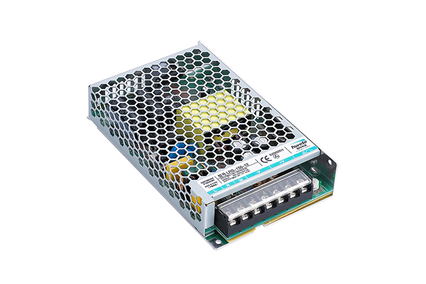
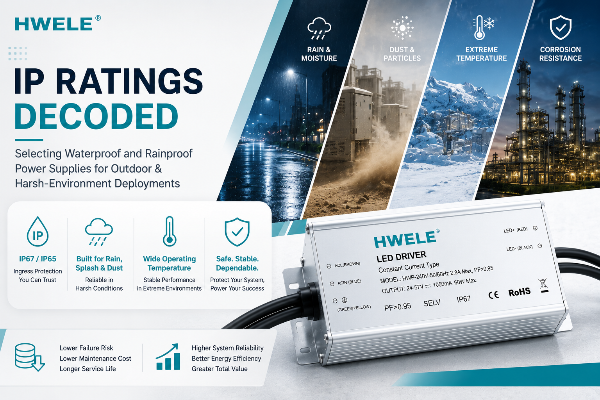
Managing multiple component sub-vendors for complex assemblies adds significant administrative friction. Partnering with a consolidated manufacturer that covers the entire power conversion lifecycle helps streamline international logistics. Zhejiang Hengwei Technology (Hwele) designs and manufactures a diverse portfolio of industrial power hardware from a centralized 6,000m² factory floor. Whether a project requires high-density single-phase DIN rail converters, heavy-duty enclosed frames, or outdoor Enclosed Power Supply modules, Hwele provides uniform component standards, simplified compliance management, and reliable lead times for global operations.
Input your control panel specifications to find the mathematically optimal DIN rail power supply configuration.
Q1: Can a three-phase DIN rail power supply continue running if one phase completely fails?
A: Yes. High-quality three-phase power units feature integrated Phase Failure Protection. This system allows the unit to seamlessly adapt and operate in Two-Phase Mode under a sustained line failure, protecting downstream automation tracking from unexpected downtime.
Q2: Is it practical to power single-phase DIN rail modules from a three-phase electrical layout?
A: Yes. You can connect a single-phase module by running lines across one phase conductor (L1) and a neutral (N) wire, or across two separate phases (L1-L2) depending on the unit’s rated voltage limits. When utilizing multiple single-phase units across a facility, ensure they are distributed evenly across all phases to maintain proper grid balance.
Q3: Why do three-phase industrial power modules exhibit significantly lower inrush current values?
A: Single-phase units draw their entire startup current along a single pathway, causing large initial spikes as the bulk capacitors charge. Three-phase power distribution naturally staggers the current draw across three distinct phase paths offset by 120 degrees, smoothing out the initial loading spike.
Q4: Do three-phase power converters offer superior energy conversion efficiency?
A: Yes. Because the rectified DC waveform inside a three-phase system is inherently smoother and suffers from much less raw voltage ripple, the internal power semi-conductors operate more efficiently. This reduces internal thermal stress and cuts energy conversion losses compared to equivalent single-phase alternatives.
Stop letting line imbalances and transient inrush currents cause unexpected system dropouts. Choose a manufacturing partner that delivers premium single-phase and three-phase industrial power solutions engineered for continuous uptime.


 Optimized by Seraphinite Accelerator