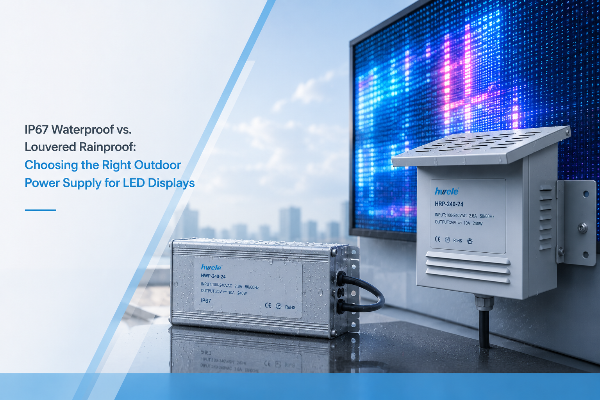


Picture this: a 200W LED driver installed inside a road-side junction box in coastal Southeast Asia. The spec sheet says “IP65 — dust-tight, water-jet protected.” Six months later, the driver fails. When the maintenance crew opens the enclosure, they find a thin layer of corrosion on the PCB terminals. Salt-laden moisture found its way past a degraded gasket, condensed on cool metal surfaces overnight, and slowly ate through the copper traces.
The IP65 rating was real — when the unit left the factory. The problem was that nobody considered how that rating would hold up against thermal cycling, salt spray, and 6 months of UV exposure on a rubber seal.
This happens more often than most procurement teams would like to admit. The root cause is almost never a defective product. It is a mismatch between the IP rating on the datasheet and the actual environmental stress the power supply endures in the field.
This guide is built to close that gap. Whether you are specifying LED drivers for a commercial outdoor lighting project, sourcing enclosed power supplies for an industrial control panel in a washdown area, or evaluating rainproof units for a CCTV surveillance deployment — you will walk away knowing exactly how to read, verify, and match IP ratings to your real-world conditions.
We will cover the IP code structure, the critical distinction between rainproof and waterproof, the heat dissipation trade-off that most selection guides ignore, environment-specific recommendations, the three ways IP ratings fail in the field, and a 7-point checklist you can send to any supplier before signing a purchase order.
IP stands for Ingress Protection (sometimes called International Protection). The standard is defined by IEC 60529 (EN 60529 in Europe, BS EN 60529:1992 in the UK). An IP rating uses a two-digit code — for example, IP67 — where each digit independently describes a type of protection.
I P 6 7
↑ Ingress Protection ↑ Solid particle protection (0–6) ↑ Liquid ingress protection (0–9K)
This digit tells you what size of solid object the enclosure blocks — from a human hand (IP1X) to microscopic dust particles (IP6X). For power supplies used outdoors or in industrial environments, you almost always want a 5 or 6.
| Digit | Protection Level | What It Blocks | Relevant to Power Supplies? |
|---|---|---|---|
| 0 | No protection | — | Not suitable |
| 1 | >50 mm objects | Back of hand | Not suitable |
| 2 | >12.5 mm objects | Fingers | Not suitable |
| 3 | >2.5 mm objects | Tools, thick wires | Indoor only |
| 4 | >1 mm objects | Small wires, screws, insects | Indoor / protected outdoor |
| 5 | Dust-protected | Limited dust ingress (no harmful accumulation) | ✅ Outdoor minimum |
| 6 | Dust-tight | Complete seal — vacuum-tested, 8-hour continuous airflow | ✅ Gold standard for outdoor PSU |
For outdoor power supplies, the first digit should always be 6 (dust-tight). A “5” is technically acceptable for some protected installations, but the cost difference between IP5X and IP6X sealing is marginal compared to the cost of a dust-related failure in the field. Don’t compromise here.
This is where most confusion lives — and where the distinction between rainproof and waterproof comes from. The second digit describes the type, pressure, and duration of water exposure the enclosure can withstand.
| Digit | Protection Type | Test Conditions | Power Supply Use Case |
|---|---|---|---|
| 0 | No protection | — | Indoor only, controlled environment |
| 1 | Vertical dripping | 1 mm/min rainfall equivalent, 10 min | Indoor, condensation only |
| 2 | Dripping (15° tilt) | 3 mm/min, 4 positions, 10 min total | Indoor, slight angle mounting |
| 3 | Spraying water (60°) | Oscillating tube, 0.07 L/min/hole, 10 min | Partially covered outdoor |
| 4 | Splashing (any direction) | Oscillating tube, 10 min | Covered outdoor, light rain |
| 5 | Water jets (6.3 mm nozzle) | 12.5 L/min, 30 kPa, 3 m distance, ≥3 min | ✅ General outdoor, rain-exposed |
| 6 | Powerful water jets (12.5 mm nozzle) | 100 L/min, 100 kPa, 3 m distance, ≥3 min | ✅ Coastal, heavy rain, vehicle splash |
| 7 | Temporary immersion | 1 m depth, 30 minutes | ✅ Flood-prone, ground-level, landscape |
| 8 | Continuous immersion | Depth & duration per manufacturer (typically >1 m) | Submersible pumps, underwater lighting |
| 9K | High-pressure, high-temperature jets | 80°C water, 8–10 MPa (80–100 bar), 0.1–0.15 m distance | Food/beverage washdown, heavy cleaning |
⚠️ Critical warning: IPX7 (immersion) does not automatically mean the unit passes IPX5 or IPX6 (water jet) tests. These are independent test protocols. A power supply rated IP67 may survive 30 minutes underwater but fail when hit with a high-pressure hose. Always check which specific digits are certified — don’t assume coverage.
Some IP codes carry an additional letter at the end — for example, IP55W or IP23S. These provide extra information about testing conditions or specific hazards:
| Letter | Meaning | When It Matters for PSU |
|---|---|---|
| W | Weather-protected (condensation, rain, humidity) | Outdoor deployments with condensation cycles |
| S | Tested while stationary | Static PSU installations (wall/panel-mounted) |
| M | Tested while in motion | Mobile equipment, vehicle-mounted PSU |
| D | Wire protection (prevents contact with hazardous parts) | Safety compliance for exposed terminal blocks |
In practice, for outdoor switching power supplies, IP66W or IP67W are the most meaningful designations — the “W” confirms the unit has been tested against weather-specific moisture threats including condensation from day/night temperature swings, not just direct water exposure.
This is where procurement mistakes happen most often. Let’s define the terms clearly:
| Property | Rainproof (IP65 / IP66) | Waterproof (IP67 / IP68) |
|---|---|---|
| Primary threat guarded | Rain, splashing, water jets from any angle | Temporary or continuous submersion in water |
| Rain & storm exposure | ✅ Designed for this | ✅ Yes, but overkill |
| Pressure washing | ❌ Not rated for this | ❌ Not rated for this (unless IP69K) |
| Temporary flooding | ❌ Will fail | ✅ IP67: 30 min at 1 m |
| Continuous underwater | ❌ Will fail immediately | ✅ IP68: manufacturer-specified depth/time |
| Heat dissipation | ✅ Good — partial airflow through breather vents | ⚠️ Compromised — fully sealed = trapped heat |
| Typical cost vs. IP20 | +25–40% | +50–80% |
| Best deployment | Wall/ pole/ ceiling-mounted outdoors | Ground-level, flood-prone, landscape, marine |
Rainproof (IP65/IP66) covers 90% of outdoor power supply applications. If your PSU is mounted on a wall, pole, or inside a ventilated enclosure exposed to rain — IP65 is sufficient. IP66 adds a safety margin for coastal spray, heavy vehicle splash, or locations where maintenance crews might use hoses nearby.
Waterproof (IP67/IP68) is necessary only when the PSU might sit in standing water — ground-level landscape lighting, drainage areas, flood-prone junction boxes, or marine applications. If your PSU is elevated even 30 cm above ground level and not in a flood zone, IP67 is over-engineering that you pay for twice: once in unit cost, and again in reduced thermal performance.
💡 Pro tip: For LED drivers mounted inside a streetlight pole base — the most common outdoor PSU scenario — IP65 with good gasketing is the sweet spot. The pole base is elevated, ventilated, and protected from direct submersion. Spending 50% more for IP67 buys you protection against a flood scenario that would also destroy the LED luminaire itself, rendering the driver’s survival irrelevant.

Here is a fact that most IP rating guides conveniently skip: a higher IP rating directly competes with thermal performance.
A switching power supply converts AC to DC with 85–93% efficiency. The remaining 7–15% becomes heat — and that heat must leave the enclosure. At IP54 and below, convection airflow through vents handles this naturally. At IP65 and above, the vents are sealed, and heat can only escape through the enclosure surface (radiation and limited convection). At IP67/IP68, the enclosure is hermetic — heat dissipation relies almost entirely on surface radiation.
Every 10°C increase in internal operating temperature reduces electrolytic capacitor lifespan by approximately 50% (Arrhenius equation). A power supply running at 50°C internally instead of 40°C will have roughly half the service life — even if both carry the same IP rating on paper.
| IP Rating | Cooling Mechanism | Typical ΔT (internal vs. ambient) | Derating Impact |
|---|---|---|---|
| IP20–IP44 | Convection (vented enclosure) | +5–10°C | Minimal — full rated power at rated ambient |
| IP54 | Limited convection, surface radiation | +10–15°C | Slight derating above 40°C ambient |
| IP65 | Surface radiation only (no vents) | +15–25°C | Typical derating: -2% rated power / °C above 40°C |
| IP66 | Surface radiation only | +18–28°C | Similar to IP65; gasket design may add 2–3°C |
| IP67 | Hermetic — surface radiation only | +20–35°C | Most aggressive derating; may need 30%+ oversizing |
| IP68 | Hermetic + water-cooled surface | Variable (water acts as heatsink) | Submersion improves cooling, but startup above water = worst case |
Never select an IP rating in isolation. Always cross-reference the PSU datasheet’s temperature derating curve. If a 200W IP67-rated power supply derates to 140W at 50°C ambient, but your application needs a continuous 180W, you have two choices:
The smarter engineering choice is often option 2 — matching the protection level to the actual threat rather than defaulting to “the highest IP rating available.”
Below is a consolidated reference covering every IP rating relevant to switching power supply and LED driver deployments. Use this as your go-to lookup table during specification.
| IP Rating | Solid Protection | Liquid Protection | Best For | Avoid In |
|---|---|---|---|---|
| IP20 | Finger-safe (>12.5 mm) | None | Indoor control panels, dry rooms | Any outdoor or humid environment |
| IP44 | >1 mm objects | Splashing (any direction) | Covered outdoor, under eaves | Direct rain, dust environments |
| IP54 | Dust-protected (limited) | Splashing (any direction) | Partially covered outdoor, warehouses | Heavy rain, water jets, dust storms |
| IP65 | Dust-tight (6) | Low-pressure water jets (6.3 mm nozzle) | Most outdoor LED drivers & PSU | Immersion, pressure washing |
| IP66 | Dust-tight (6) | Powerful water jets (12.5 mm nozzle) | Coastal, vehicle splash, heavy rain | Immersion, pressure washing |
| IP67 | Dust-tight (6) | Temporary immersion (1 m, 30 min) | Flood-prone, ground-level, landscape | Permanent underwater, pressure washing |
| IP68 | Dust-tight (6) | Continuous immersion (mfr-specified) | Submersible, marine, fountain | Assume all IP68 = same depth — they differ |
| IP69K | Dust-tight (6) | High-pressure, high-temp jets (80°C, 80–100 bar) | Food processing, pharmaceutical washdown | Immersion (different test protocol) |
Different deployment scenarios place fundamentally different stresses on a power supply enclosure. Here is how to match IP ratings to your specific environment.
| Mounting Location | Recommended IP | Rationale |
|---|---|---|
| Pole-mounted (driver in luminaire head) | IP65 | Elevated, exposed to rain/wind/dust. No immersion risk. |
| Pole base / junction box | IP66 | Ground-level, splash from vehicles, potential water accumulation. |
| Flood-prone area | IP67 | Temporary submersion possible during heavy rain / flooding. |
| Coastal / salt-spray zone | IP66 + anti-corrosion | Salt mist is a water jet threat; IP66 with 316 stainless hardware and silicone gaskets. |
| Zone | Recommended IP | Notes |
|---|---|---|
| Dry control panel room | IP20–IP44 | Ventilation priority over sealing. |
| Dusty production floor (packaging, woodworking) | IP54–IP65 | Dust protection (5 or 6) is the driver here. Liquid protection secondary. |
| Washdown area (food / beverage / pharma) | IP69K | Anything below IP69K in a washdown zone is “a ticking time bomb.” High-temp, high-pressure jets demand the highest rating. |
| Outdoor industrial (loading dock, tank farm) | IP66 | Vehicle splash, occasional hose-down, all-weather exposure. |
| Installation | Recommended IP | Why |
|---|---|---|
| Indoor ceiling / wall | IP20–IP40 | Low cost, adequate for conditioned spaces. |
| Outdoor building-mounted | IP65 | Rain-exposed but elevated. No immersion risk. |
| Outdoor gate / perimeter (ground-level) | IP66–IP67 | Closer to ground, splash from vehicles, potential temporary flooding. |
If your project specification uses NEMA ratings (common in North American projects), here is the approximate equivalence:
| IP Rating | Approx. NEMA | NEMA Scope |
|---|---|---|
| IP54 | NEMA 3 | Outdoor, rain/sleet/dust |
| IP65 | NEMA 4 | Watertight, hose-directed water |
| IP66 | NEMA 4X | Watertight + corrosion-resistant |
| IP67/68 | NEMA 6/6P | Submersible, temporary/prolonged |
⚠️ Important: IP and NEMA are not 1:1 equivalents. NEMA adds testing for corrosion, gasket aging, ice formation, and oil exposure — factors that IP (IEC 60529) does not address. If a project specification requires NEMA 4X, an IP66 power supply alone does not automatically satisfy it. Always confirm with the specifier.
An IP rating describes the enclosure’s performance in a controlled laboratory test. It does not tell you:
| Material | Temperature Range | UV Resistance | Best For |
|---|---|---|---|
| Silicone | -55°C to +200°C | ✅ Excellent | Outdoor LED drivers, solar-exposed PSU |
| EPDM (Ethylene Propylene) | -40°C to +125°C | ⚠️ Moderate | Indoor / covered outdoor, cost-effective |
| Neoprene | -30°C to +100°C | ⚠️ Moderate | General industrial, oil exposure |
| Nitrile (NBR) | -30°C to +100°C | ❌ Poor | Oil-resistant, indoor only |
For outdoor power supplies in direct or partial sunlight, specify silicone gaskets. The material cost difference is typically under $1 per unit — negligible compared to the cost of a gasket failure in year 3 or 4.
An IP rating is a factory certification, not a lifetime warranty. Here are the three mechanisms that degrade seal integrity over time — and how to mitigate each one.
Mechanism: During the day, internal electronics heat the enclosure. The air inside expands and exits through the path of least resistance — typically the cable gland or gasket seam. At night, the enclosure cools. The contracting air creates a partial vacuum, drawing moist outside air back through the same micro-channels.
Over hundreds of cycles, this “breathing” carries water vapor inside, where it condenses on cool metal surfaces (PCB traces, transformer cores, terminal blocks). The result: corrosion that grows from the inside out.
Mitigation:
Mechanism: Cleaning agents, industrial solvents, diesel exhaust particulates, and even certain de-icing salts chemically attack rubber gaskets. The gasket hardens, shrinks, or becomes brittle — creating gaps in what was once a dust-tight seal.
A classic example: food processing plants use alkaline foam cleaners that can reduce an EPDM gasket to crumbling rubber within 12–18 months. The enclosure still carries the IP69K label, but the seal is effectively IP00.
Mitigation:
Mechanism: Constant vibration — from nearby machinery, vehicle traffic, or wind buffeting on pole-mounted installations — gradually loosens cable glands, screw terminals, and enclosure fasteners. A 1mm gap around a cable entry is all it takes to compromise an otherwise perfect IP67 seal.
Mitigation:
Before you sign a purchase order for any outdoor or harsh-environment power supply, send this checklist to your supplier. If they cannot answer every point with supporting documentation, dig deeper.
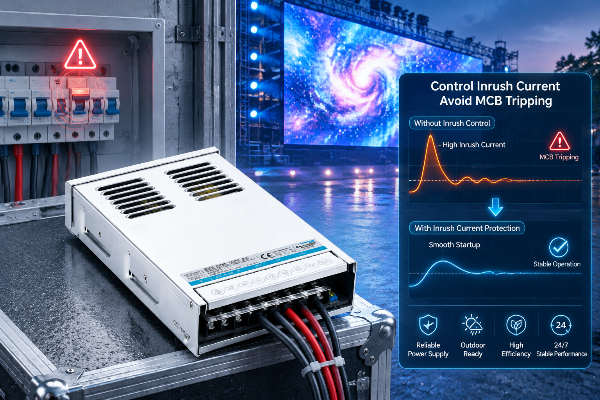
At HWELE, we design and manufacture switching power supplies and LED drivers with IP ratings matched to real deployment conditions — not just to the highest number on a datasheet. Our approach combines robust ingress protection with thermal engineering that keeps your power supply running at its rated power, not a derated fraction of it.
| Specification | Details |
|---|---|
| Power Range | 6W – 320W |
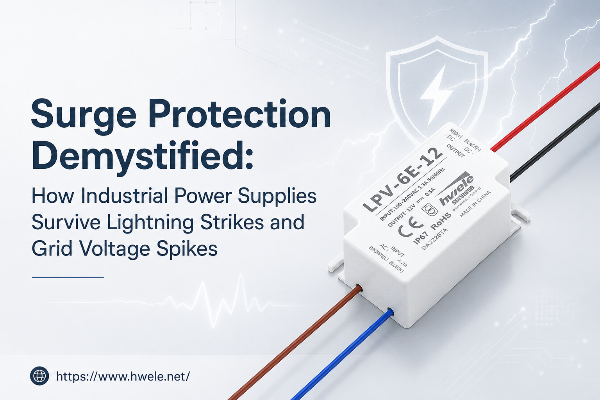
| IP Rating | IP67 — Dust-tight + temporary immersion (1 m / 30 min) |
| Best Deployment | Outdoor LED lighting: street lights, flood lights, landscape lighting, tunnel lighting, parking lot fixtures |
| Gasket Material | Silicone — UV-resistant, wide temperature range |
| Certifications | CE, KC, 3C, UL (select models) |
| Specification | Details |
|---|---|
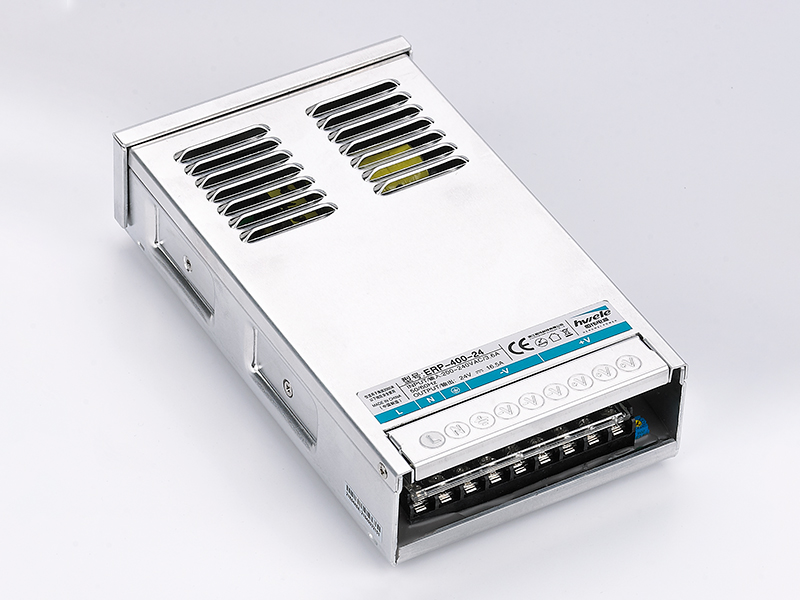
| Power Range | 350W – 400W |
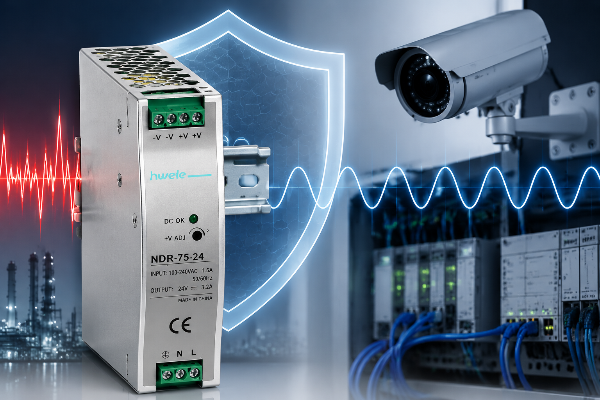
| Protection Level | Rainproof — designed for rain-exposed outdoor, covered outdoor, and semi-exposed industrial installations |
| Best Deployment | CCTV surveillance systems, access control panels, outdoor telecom enclosures, industrial control cabinets in covered outdoor areas |
| Key Advantage | Optimized balance of weather protection and thermal performance — no unnecessary derating from hermetic sealing |
| Certifications | CE, KC, 3C, ISO9001, ISO14001 |
| Specification | Details |
|---|---|
| Power Range | 10W – 600W |
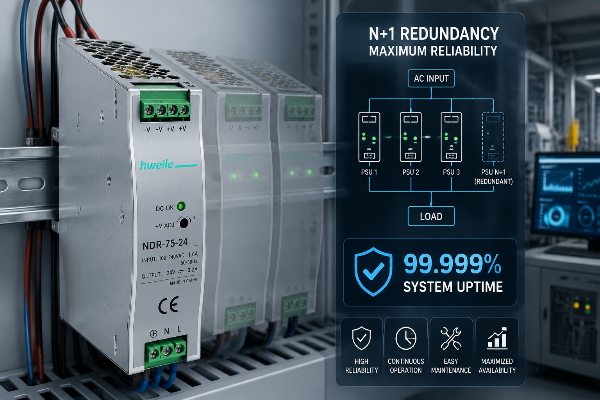
| IP Rating | IP20 — finger-safe, designed for integration into larger enclosures |
| Best Deployment | Industrial control panels, automation cabinets, indoor LED displays, medical device power integration |
HWELE provides OEM/ODM custom power supply solutions — including custom IP-rated enclosures, connector configurations, cable gland specifications, and conformal coating options — engineered to your exact deployment environment.
20+ years of switching power supply manufacturing. CE / KC / 3C / UL certified. ISO9001 & ISO14001 quality management.
IP65 protects against low-pressure water jets (6.3 mm nozzle, 12.5 L/min) from any direction, with a dust-tight enclosure. IP67 protects against temporary immersion in water up to 1 meter for 30 minutes, also dust-tight. The key practical difference: IP65 handles rain, splashing, and hose-down. IP67 handles being briefly submerged — but may trap more heat due to hermetic sealing. For most elevated outdoor PSU installations, IP65 is the right choice. Choose IP67 only when standing water is a real risk.
Yes — for the vast majority of outdoor LED driver applications. IP65 guarantees complete dust protection and resistance to low-pressure water jets from any angle, covering rain, wind-driven rain, and splashing. The exceptions: (1) the driver is at ground level in a flood-prone area — go IP67; (2) the driver is in a coastal zone with salt spray — go IP66 with anti-corrosion hardware; (3) the installation involves pressure washing — go IP69K.
No. Rainproof (IP65/IP66) ratings certify protection against defined water jet tests at specific pressures (30 kPa for IPX5, 100 kPa for IPX6). A commercial pressure washer operates at 8,000–15,000 kPa (80–150 bar) — roughly 80–150× the IP66 test pressure. A rainproof PSU hit with a pressure washer will almost certainly suffer water ingress. If your deployment environment requires pressure washing, specify IP69K-rated enclosures.
Yes — and this is the single most overlooked factor in IP rating selection. As IP rating increases, the enclosure becomes more sealed, reducing or eliminating convection airflow. An IP65 sealed PSU runs 15–25°C hotter internally than an IP20 vented equivalent at the same load. An IP67 hermetic unit can be 20–35°C hotter. This directly shortens component lifespan: every 10°C increase roughly halves electrolytic capacitor life. Always check the temperature derating curve alongside the IP rating.
Rainproof (IP65/IP66) means the PSU is designed to keep water out under rain, splashing, and water jet conditions — but not under immersion. Waterproof (IP67/IP68) means the PSU can survive being submerged, temporarily (IP67) or continuously (IP68). They address different threat profiles. For a PSU mounted on a wall, pole, or inside a ventilated enclosure — rainproof is appropriate. For a PSU that may sit in standing water — waterproof is necessary.
No. IP67 is rated for temporary immersion only — 30 minutes at a maximum depth of 1 meter. For permanent underwater installation, you need IP68, and you must confirm the manufacturer’s specified depth and duration ratings. Not all IP68 products are rated for the same depth; the standard allows manufacturers to define their own test parameters beyond 1 meter.
Request the third-party test report from an independent laboratory certified to test per IEC 60529. Self-declared IP ratings without lab verification are not reliable. The report should include: test lab name and accreditation, report number, test date, test conditions (nozzle size, pressure, duration, depth), and pass/fail criteria. Also verify the IP rating applies to the complete assembly — enclosure plus cable glands plus connectors — not just the bare enclosure.
The minimum is IP65 for any outdoor power supply. Upgrade to IP66 for coastal areas (salt spray), locations near vehicle traffic (splash), or heavy-rain regions. IP67 only if the PSU is at ground level in a flood-prone area. IP69K only for food/beverage/pharma washdown zones. There is no one-size-fits-all answer — match the IP rating to the specific water threat your deployment faces.
Yes. Three mechanisms degrade IP seal integrity: (1) thermal cycling — day/night expansion/contraction pumps moisture past seals; (2) chemical degradation — cleaning agents, solvents, and pollutants attack gasket materials; (3) mechanical vibration — loosens cable glands and fasteners. An IP67 unit installed 5 years ago may no longer meet IP67 without gasket replacement. Annual visual inspection of gasket condition and cable gland tightness is recommended for critical outdoor installations.
IP ratings (IEC 60529) focus on dust and water ingress protection only. NEMA ratings (NEMA 250) additionally evaluate corrosion resistance, gasket aging, ice formation, and oil exposure. Approximate equivalents: IP65 ≈ NEMA 4, IP66 ≈ NEMA 4X, IP67/IP68 ≈ NEMA 6/6P. However, they are not 1:1 equivalents — a NEMA 4X rating implies corrosion testing that an IP66 rating does not. If a project specification requires NEMA compliance, an IP certification alone may not satisfy it.
Published by HWELE — Switching Power Supply & LED Driver Manufacturer. 20+ Years of Experience. CE / KC / 3C / UL Certified.


 Optimized by Seraphinite Accelerator