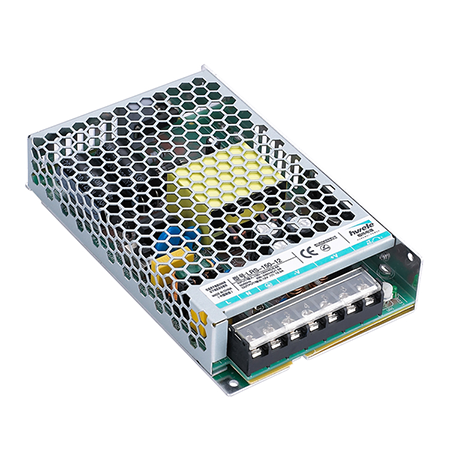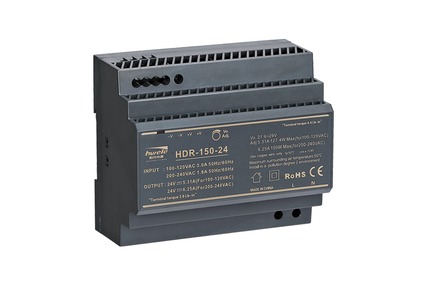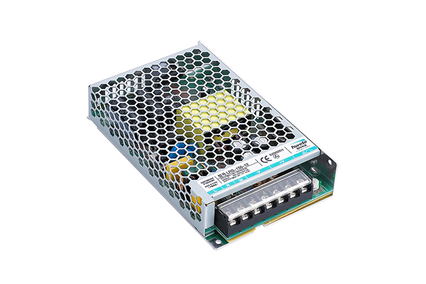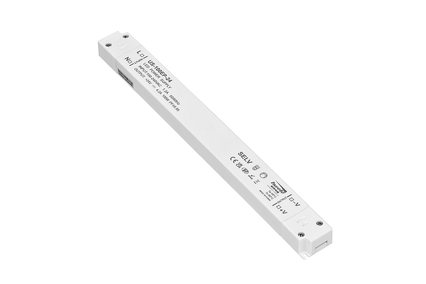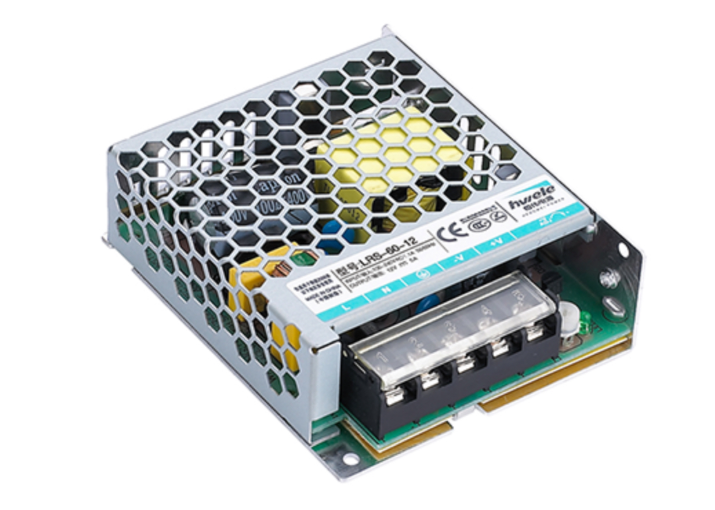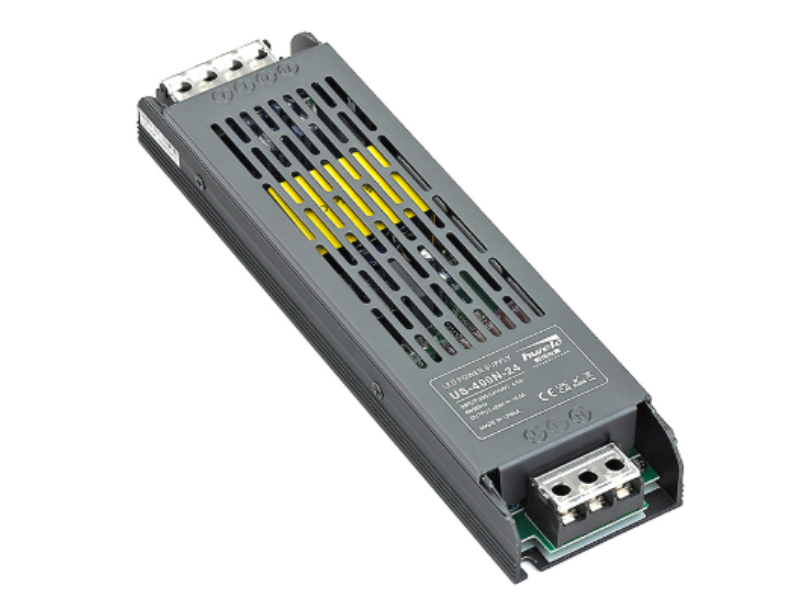


Compact EV chargers, payment kiosks, and vending machines all fight the same enemy: no room. An ultra-thin 150 W switching power supply delivers the power a controller, screen, and peripherals need while occupying a sliver of the enclosure depth. The engineering trick is moving heat out of a shallow profile through careful layout and a low-profile, high-density topology. HENGWEI’s LRS-150F and the purpose-built 150 W charging-station supply show how thin can still mean reliable.
Modern self-service hardware is getting thinner while doing more. A kiosk must look like furniture; an AC charger must tuck behind a bollard. The power supply—often the bulkiest component—becomes the bottleneck. Shaving enclosure depth from 80 mm to 30 mm can decide whether a product fits its industrial-design brief at all.
The LRS-150F 150 W uses a low-profile, high-frequency topology with flat-wound magnetics and surface-mounted thermal paths so it slides into a shallow tray. Key traits: universal input, 12/24 V selectable output, and overtemperature/overload protection—everything a compact controller rail needs in one slim package.
Less depth means less metal to sink heat. The mitigation is threefold: (1) spread loss components across the PCB so no hot spot forms; (2) leave a convection gap above the supply; (3) rely on the enclosure wall as a secondary heatsink via conduction pads. At 150 W and 90% efficiency, ~15 W becomes heat—manageable in a thin box if you plan the airflow, not if you bury it.
The 150 W ultra-thin charging-station supply targets exactly this: a control/auxiliary rail inside a charger where the main power stage is separate. It feeds the RFID reader, display, and comms while staying slim enough for the charger’s shallow cavity. Specifying an auxiliary supply already tuned for the application avoids a custom bracket.
| Load | Typical draw | Fit note |
|---|---|---|
| Controller + display | 40–70 W | Slim 150 W has headroom |
| Receipt printer / scanner | 30–60 W peak | Watch inrush on motor/print head |
| Comms / RFID | 5–15 W | Negligible |
One 150 W ultra-thin unit comfortably covers a kiosk’s auxiliary rail with margin for peaks.
Measure the available depth, then pick the thinnest supply that meets load + a 25% margin. If your cabinet hits 50 C ambient, derate per the curve. A 150 W ultra-thin part at 50 C ambient still safely feeds most kiosk auxiliaries; pushing it to 150 W in a sealed 60 C box is where you risk thermal shutdown.
Q: How thin is ‘ultra-thin’ 150 W?
A: Profile-class supplies like the LRS-150F are in the low-30 mm height range—roughly a third of a traditional enclosed brick, built to slide into shallow trays.
Q: Can one 150 W unit run a whole kiosk?
A: For the auxiliary rail (controller, display, printer, RFID) yes, with margin. The main AC charging or high-power stage is a separate supply; the 150 W backs the electronics.
Q: What about heat in a sealed enclosure?
A: Plan convection or use the enclosure wall as a heatsink. At 150 W / ~90% efficiency the wasted heat is ~15 W—manageable if not buried.


 Optimized by Seraphinite Accelerator