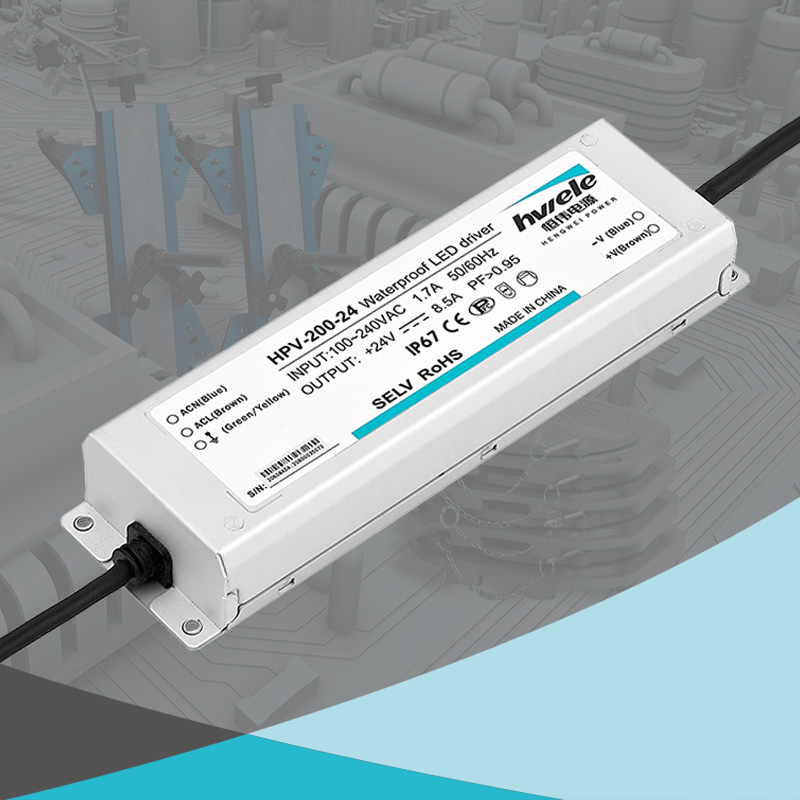


When it comes to designing efficient and reliable LED lighting systems, choosing the right LED driver is critical. Whether you’re powering LED strips in decorative lighting or high-intensity LEDs in industrial fixtures, the type of driver you select directly affects brightness, efficiency, and lifespan. However, many people still ask: what are the two types of drivers, and how do LED drivers work? This guide explains the difference between Constant Voltage and Constant Current LED Drivers, helping you make the best choice for your project.

A Constant Voltage LED Driver delivers a fixed output voltage, typically 12V or 24V DC, while allowing the current to vary according to the load. These LED drivers are commonly used with LED strips, modules, or systems that already have built-in current regulation, such as resistors or internal circuits.
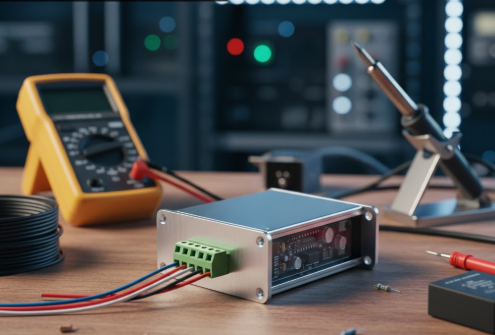
A Constant Current LED Driver maintains a fixed current output (e.g., 350mA, 700mA, or 1050mA) while automatically adjusting the voltage to match the LED’s needs. This makes them ideal for high-power LEDs that require precise current control to prevent damage and ensure consistent brightness.
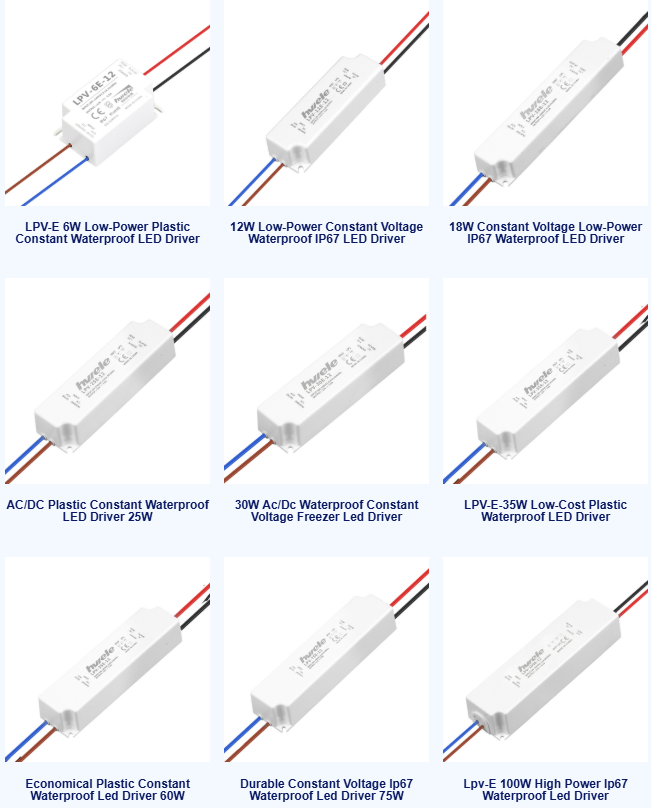
Constant Voltage (CV): Outputs a fixed DC voltage such as 12V or 24V, while the current varies depending on the load. The driver’s job is to maintain voltage stability.
Constant Current (CC): Outputs a fixed current value — for example 350mA, 700mA, or 1050mA — and automatically adjusts the output voltage to keep that current constant.
Practical Impact:
Constant voltage LED drivers are suitable for LED strips or modules with built-in resistors or internal current regulators, while constant current LED drivers are used for bare or high-power LEDs that require accurate current control to prevent damage.
Constant Voltage Driver: Uses a voltage-regulating circuit (switching or linear regulator) to keep output voltage steady; as the load changes, the output current adjusts accordingly.
Constant Current Driver: Uses feedback control (current sensing resistors and internal regulation loops) to maintain a fixed current, varying voltage as necessary.
Technical Note:
Constant current LED drivers include current-sense resistors, control ICs, and multiple protection functions (short-circuit, over-temperature, open-circuit). Constant voltage LED drivers focus on voltage precision, ripple suppression, and transient response.
Constant Voltage Drivers: Best suited for LED strips or modules that already include current-limiting resistors or small driver ICs. These modules can be connected in parallel, each maintaining the same voltage.
Constant Current Drivers: Designed for bare LEDs, COB chips, or linear LED arrays that need precise current regulation.
Compatibility Risks:
Using a CV driver on a bare LED can lead to uncontrolled current and LED failure. Conversely, connecting LED strips (12V type) to a CC driver can cause undervoltage or overcurrent issues.
Constant Voltage: Ideal for LED strips, signage, architectural lighting, RGB lighting, cabinet lights, and smart home lighting systems (commonly 12V/24V).
Constant Current: Used in downlights, panel lights, streetlights, floodlights, and other high-power professional lighting where brightness uniformity and stability are essential.
Engineering Advice:
Choose based on LED type and connection method. For multi-parallel low-power lighting, use CV. For high-power, long-series configurations, CC ensures stability and consistency.
Constant Voltage: LEDs are typically wired in parallel, each branch receiving the same voltage. Easy to expand and control in sections.
Constant Current: LEDs are connected in series, so the same current passes through every LED. To run multiple series strings, each should have its own CC driver or a multi-channel constant current output.
Installation Note:
Avoid changing the number of LEDs in a constant current series string — it will affect voltage requirements. In CV systems, minimize voltage drop by using thicker cables or segmental power feeds.
Constant Voltage: Focuses on voltage stability, load transient response, and ripple control. Since current is not regulated, brightness may vary slightly among LEDs.
Constant Current: Focuses on maintaining a precise and stable current with low temperature drift, ensuring uniform brightness and color consistency.
Engineering Indicators:
Look for parameters like voltage accuracy (±%), current accuracy (±mA or ±%), ripple (mV), and derating curves. Premium CC drivers have better current precision and stronger protection.
Constant Voltage: Slightly lower efficiency due to energy loss in resistors or control circuits, especially in low-power applications.
Constant Current: Typically higher efficiency, as power is precisely regulated with minimal waste — critical for large-scale or high-brightness lighting systems.
Thermal Consideration:
Lower efficiency means more heat generation, which can reduce driver lifespan. In high-power lighting, using efficient constant current LED drivers with proper heat dissipation improves reliability and energy savings.
Constant Voltage Drivers: Commonly support PWM (Pulse Width Modulation) dimming, ideal for LED strips and RGB controllers. Some advanced CV drivers also support analog or smart dimming, depending on design.
Constant Current Drivers: Often compatible with 0–10V, DALI, or TRIAC dimming protocols. Many models are marketed as dimmable constant current LED drivers for professional lighting systems.
Constant Voltage: Easier to manufacture, widely available, and cost-effective — ideal for large-volume, budget-sensitive projects.
Constant Current: Slightly more expensive due to precision circuitry and additional protection features, but provides superior safety, consistency, and lifespan.
Procurement Insight:
Consider total ownership cost, not just unit price. Efficiency, certification (UL, CE, CCC), and reliability matter in long-term operation.
Constant Voltage Drivers: Simple to install, safe for low-voltage systems, but may overdrive LEDs if misused. Commonly used where low-voltage DC improves human-touch safety.
Constant Current Drivers: Safer for LEDs because they strictly control current, preventing thermal runaway and LED degradation. They typically include short-circuit, over-temperature, and surge protection for industrial-grade reliability.
Manufacturing Quality:
Premium brands like HENGWEI LED Driver use glue filling protection, anti-interference design, and excellent voltage stabilization for strong environmental adaptability. This ensures stable performance even in humid, dusty, or high-interference environments.
| Comparison Aspect | Constant Voltage LED Driver | Constant Current LED Driver |
|---|---|---|
| 1. Output Type | Provides a fixed DC voltage (typically 12V or 24V), allowing LEDs to draw the current they need. | Delivers a fixed output current (e.g., 350mA, 700mA, 1050mA), automatically adjusting voltage to maintain that current. |
| 2. Working Principle | Maintains a stable voltage regardless of current fluctuations. The current depends on the LED load. | Maintains a constant current regardless of voltage variations, ensuring consistent light output. |
| 3. LED Compatibility | Suitable for LED strips, signage, and modules with built-in resistors or internal drivers. | Designed for high-power LEDs that require precise current control for brightness and longevity. |
| 4. Application Scenarios | Commonly used in architectural lighting, retail displays, decorative and flexible LED strips. | Ideal for industrial lighting, downlights, panel lights, floodlights, and professional LED fixtures. |
| 5. Connection Method | LEDs are connected in parallel; each LED receives the same voltage. | LEDs are connected in series; current flows equally through all LEDs. |
| 6. Output Regulation | Regulates voltage but not current — brightness may vary slightly between LEDs of different characteristics. | Regulates current precisely — ensures consistent brightness, color uniformity, and thermal stability. |
| 7. System Efficiency | Slightly lower efficiency due to energy loss across resistors or internal circuits. | Higher efficiency, as power is delivered directly based on the LED’s current requirement. |
| 8. Dimming Compatibility | Typically supports PWM dimming or simple analog dimming; ideal for ambient lighting. | Compatible with advanced 0–10V, DALI, TRIAC, or DMX dimming systems; suitable for smart lighting control. |
| 9. Cost and Availability | More affordable, widely available in consumer and commercial markets. | Slightly more expensive due to tighter current regulation and higher component precision. |
| 10. Safety and Reliability | Easy to install, but improper LED matching can cause overcurrent and shorten lifespan. | Offers better LED protection by preventing overcurrent and thermal damage; extends LED life. |
| 11. Voltage Flexibility | Available in standard voltages (12V, 24V, 36V, 48V). Limited adaptability to different LED loads. | Automatically adjusts voltage output within a specified range to match LED requirements. |
| 12. Power Supply Stability | Voltage drop may occur over long cable distances; requires careful wiring design. | Stable output current ensures consistent brightness even with cable length variations. |
| 13. Thermal Management | Generates moderate heat; suitable for environments with good ventilation. | Generates less heat due to higher efficiency, improving LED driver circuit lifespan. |
| 14. Typical Design Example | Used in setups with multiple low-power LEDs powered by a single HENGWEI LED driver. | Used in systems where high-power LEDs require precise current regulation using a constant current LED power supply. |
| 15. Maintenance and Installation | Simple installation — ideal for DIY users and flexible LED systems. | Requires correct LED matching — more technical but ensures professional lighting performance. |
| 16. Use in Smart Lighting | Limited integration with intelligent control systems. | Fully compatible with dimmable constant current LED drivers and smart lighting networks. |
| 17. Lifespan and Reliability | Good performance when paired correctly, but susceptible to LED mismatch. | Superior reliability; prevents flicker, overcurrent, and extends LED service life significantly. |
| 18. Product Example (HENGWEI) | HENGWEI Constant Voltage LED Driver — ultra-thin design, stable voltage output, easy installation, strong anti-interference ability. | HENGWEI Constant Current LED Driver — precise current control, high efficiency, stable performance, suitable for professional lighting. |
Understanding the difference between Constant Voltage and Constant Current LED Drivers is essential for building safe, efficient, and durable lighting systems. Constant voltage drivers are best for low-power and flexible lighting, while constant current drivers deliver precision and protection for high-power LEDs.Whether you need constant current LED drivers, dimmable LED power supplies, or customized LED driver parts, HENGWEI LED Drivers provide the quality and performance trusted by professionals worldwide.


 Optimized by Seraphinite Accelerator