

As industrial systems become more compact, modular, and intelligent, the way power is distributed inside control cabinets has changed. Traditional bulky power supplies are gradually being replaced by standardized, easy-to-install solutions. The DIN rail power supply was designed to meet these needs. It supports fast installation, clean wiring, and reliable operation in demanding environments. Today, it is widely used in automation systems, PLC panels, process control equipment, and infrastructure projects.
However, not every application automatically requires a DIN rail power supply. Understanding DIN rail power supply applications helps engineers make better design decisions and avoid mismatches between power supply type and system needs.
A DIN rail power supply is a type of industrial power supply designed to be mounted on a standard DIN rail. DIN rails are metal mounting rails commonly used in electrical panels and control cabinets worldwide.
A DIN rail mounted power supply typically converts AC input voltage into a stable DC output such as 24V, 12V, or 48V. Among these, 24V DC is the most common voltage used in automation systems.
Unlike open frame or enclosed box power supplies, DIN rail models are designed for vertical mounting, tool-free installation, and easy replacement. They usually feature slim housings to save cabinet space and front-facing terminals for clean wiring.
In industrial environments, this format offers both mechanical and electrical advantages.

DIN rail power supplies are widely used not because they are fashionable, but because they solve real problems faced by automation engineers.
First, they simplify installation. A DIN rail power supply can be snapped onto the rail without drilling holes or custom brackets. This speeds up panel assembly and reduces labor cost.
Second, they support modular design. Automation systems often expand over time. DIN rail mounting allows engineers to add or replace power supplies without redesigning the entire cabinet.
Third, they improve maintenance. If a power supply fails, it can be removed and replaced quickly without disturbing other components.
Finally, DIN rail power supplies are designed specifically for industrial environments. They typically offer wide input voltage range, strong protection features, and reliable operation under continuous load.
For these reasons, DIN rail power supply applications continue to grow across many industries.
| Application Area | Typical Equipment Powered | Why DIN Rail Power Supplies Are Used | Hengwei Product Suggestion |
| Industrial Automation and PLC Systems | PLCs, I O modules, sensors, relays | Stable 24V output, easy integration in automation panels, high reliability | Hengwei DIN Rail Power Supply 10–480W |
| Control Cabinets and Electrical Panels | Control relays, terminals, controllers | Space-saving mounting, clean wiring, fast installation and replacement | Hengwei DIN Rail Power Supply HDR Series |
| Manufacturing and Process Control Equipment | Valves, actuators, control circuits | Continuous operation support, protection against overload and surge | Hengwei DIN Rail Power Supply MDR Series |
| Energy and Infrastructure Systems | Monitoring devices, communication modules | Wide input voltage range, stable operation under grid fluctuation | Hengwei DIN Rail Power Supply NDR Series |
| Test, Measurement, and Monitoring Equipment | Data acquisition units, analyzers | Low ripple, stable output for accurate measurement | Hengwei DIN Rail Mounted Power Supply |
One of the most common uses of power supply for PLC systems is DIN rail mounting.
PLCs, I O modules, sensors, and communication devices usually require stable 24V DC power. DIN rail power supplies are ideal for this role because they provide consistent output and can handle load changes caused by machine operation.
In automation systems, power stability directly affects control accuracy. Voltage drops or fluctuations can lead to PLC resets or sensor errors. A well designed DIN rail power supply helps avoid these issues.
For automation panels requiring reliable DC power, Hengwei DIN Rail Power Supply 10–480W series is commonly used to support PLC systems and field devices.
Control cabinets are the central nervous system of industrial equipment. Inside these cabinets, space is limited and organization is critical.
DIN rail power supplies fit naturally into this environment. Their slim design allows multiple devices to be installed neatly along the rail. Front-side wiring makes cable routing clear and easy to inspect.
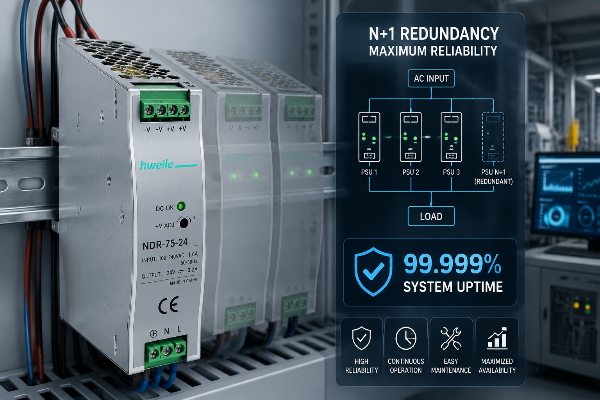
In control panels, multiple power supplies may be used to separate loads or support redundancy. DIN rail mounting allows this flexibility without increasing cabinet complexity.
For panel builders, standardized DIN rail installation also simplifies documentation and repeat production.
Manufacturing equipment often runs continuously for long periods. Downtime can be extremely costly.
DIN rail power supplies are designed for continuous operation and high reliability. They are widely used to power control circuits, relays, valves, and sensors in process control systems.
In environments with vibration, temperature variation, or electrical noise, DIN rail power supplies designed for industrial use offer better stability than general purpose power adapters.
For medium power control circuits, Hengwei DIN Rail Power Supply MDR Series Plastic 10–100W provides a compact and cost effective solution for process equipment.
Energy and infrastructure projects often involve distributed control systems. These systems require stable DC power for monitoring and communication devices.
DIN rail power supplies are commonly used in energy monitoring systems, substation control panels, traffic control equipment, and building automation systems.
Their wide input voltage tolerance and strong protection features help them cope with unstable grid conditions often found in infrastructure projects.
In such systems, DIN rail power supplies support long-term unattended operation with minimal maintenance.
Test and measurement equipment requires clean and stable power. Noise or voltage ripple can affect measurement accuracy.
DIN rail power supplies are often used in monitoring cabinets, data acquisition systems, and test racks. Their regulated output helps ensure reliable data collection.
For applications where multiple instruments need stable DC power, DIN rail mounting provides a clean and organized solution.
Not all DIN rail power supplies are equal. Industrial applications demand specific features.
Wide input voltage range allows operation in unstable power environments. High efficiency reduces heat buildup inside cabinets. Protection features such as overcurrent, overvoltage, and short circuit protection protect both the power supply and connected equipment.
Thermal design is also critical. DIN rail power supplies are often installed close to other heat-generating devices. Good heat dissipation ensures long service life.
Mechanical robustness and vibration resistance are important in factory environments.
Hengwei DIN Rail Power Supply NDR Series Aluminum 75–480W is designed to meet these industrial requirements with durable housing and stable performance.
Choosing the right DIN rail power supply starts with understanding your system requirements.
First, calculate total load and include a reasonable power margin. Automation systems often experience peak loads during startup.
Second, choose the correct output voltage. 24V DC is standard for most PLC systems, but some applications require 12V or 48V.
Third, consider environmental conditions. Temperature, humidity, and vibration affect power supply performance.
Fourth, check protection features and certifications. Industrial projects often require compliance with safety standards.
Finally, consider future expansion. DIN rail systems are modular by nature, so leaving room for growth is good practice.
For compact control cabinets, Hengwei DIN Rail Power Supply HDR Series Plastic 15–150W offers space-saving design and reliable output.

Modern automation emphasizes flexibility, scalability, and reliability. DIN rail power supplies align perfectly with these goals.
They support modular system design, which makes automation systems easier to upgrade and maintain. Their standardized mounting simplifies global production and documentation.
As factories move toward smarter and more connected systems, stable power becomes even more critical. DIN rail power supplies provide the foundation for reliable automation.
For automation engineers, choosing DIN rail mounting is not just a mechanical decision. It is a system level design choice that improves long-term performance.
The DIN rail power supply has become a cornerstone of industrial automation systems. Its ability to deliver stable DC power, support modular design, and simplify installation makes it ideal for PLC systems, control cabinets, manufacturing equipment, and infrastructure projects.
Understanding DIN rail power supply applications helps control panel designers and automation engineers choose the right solution for their systems.
Whether you are designing a new automation panel or upgrading an existing system, selecting the right DIN rail mounted power supply improves reliability, reduces maintenance, and supports future expansion.
Hengwei DIN Rail Power Supply solutions provide flexible options for different power levels, environments, and applications, helping industrial systems operate smoothly and efficiently.
Q1: What is a DIN rail power supply mainly used for?
A1: A DIN rail power supply is mainly used to provide stable DC power for PLCs, sensors, relays, and control devices inside industrial control cabinets. It is commonly used in automation systems, electrical panels, and process control equipment.
Q2: Why are DIN rail power supplies popular in PLC systems?
A2: DIN rail power supplies are popular as a power supply for PLC systems because they provide stable 24V output, are easy to install, and fit neatly into control cabinets. Their reliability and modular design make maintenance and expansion easier.
Q3: What output voltage is most common for DIN rail power supplies?
A3: 24V DC is the most common output voltage because it is widely used by PLCs, sensors, and industrial control equipment. Some applications may also use 12V or 48V depending on system requirements.
Q4: How do I know what wattage DIN rail power supply I need?
A4: You should calculate the total power consumption of all connected devices and add a margin of about 20 to 30 percent. This helps the DIN rail mounted power supply handle startup current and future expansion.


 Optimized by Seraphinite Accelerator