

If you deploy switching power supplies above 5,000 m or in sub-zero cold, the datasheet rating no longer applies as-is. Thin air weakens convective cooling and shrinks creepage clearance, while temperatures below -30 C raise inrush current and stress electrolytic capacitors. The fix is not a special part—it is correct derating and a cold-start-aware design. HENGWEI enclosed and DIN-rail units are specified with published derating curves; size to those curves and your system stays reliable from sea level to the mountaintop.
Most engineers size a supply from its output wattage and move on. At sea level and 25 C that works. Once the unit sits in a Himalayan telecom hut or an Arctic cabinet, two physical effects quietly erode that margin:
Altitude lowers air density, so convective and even fan-driven cooling delivers less heat away; it also reduces the breakdown strength of air, tightening the effective creepage/clearance you can rely on. Cold-start changes the components themselves—electrolytic capacitors lose capacitance and rise in ESR at low temperature, and the cold input stage can draw a large inrush spike the first time it powers on.
As pressure drops, the heat-transfer coefficient of air falls. A supply convection-cooled at sea level may run 10–15 C hotter at 5,000 m for the same load. The standard industry rule of thumb is to derate output power by about 1% per 100 m above 2,000 m, capping the usable altitude around 5,000 m (or per the stated limit, often 3,000–5,000 m for safety standards such as IEC/EN 62368-1).
At -30 C and below, the dominant risk is not continuous power but the first switch-on. Electrolytic capacitors specified to -40 C may still start, but their ESR climbs sharply, so the inrush current through the input rectifier and NTC thermistor spikes. A supply with a soft-start or controlled inrush limiter avoids tripping the upstream breaker or welding the relay. Where the environment stays below -30 C for long periods, verify the capacitor’s low-temperature endurance rating, not just its storage limit.
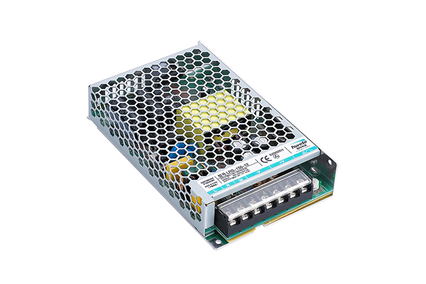
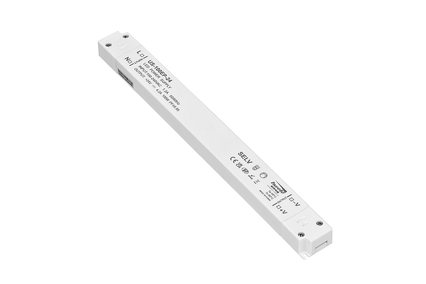
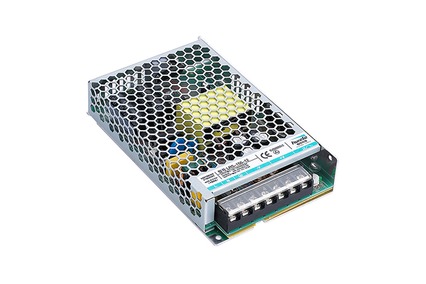
HENGWEI’s ultra-thin enclosed family (for example the LRS-150F 150 W) is built for industrial cabinets where altitude and ambient temperature both vary. The published specification sheet gives a load-vs-temperature derating curve and an operating-altitude limit; treat that curve as the contract. If your cabinet internal ambient can reach 60 C at 4,000 m, read the intersection on the curve and derate accordingly rather than trusting the 150 W label.
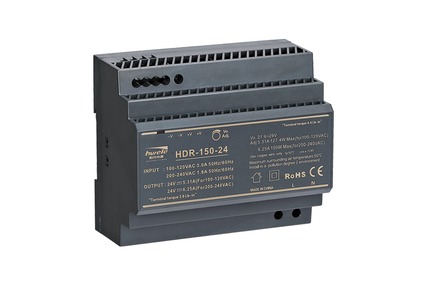
DIN-rail supplies such as the NDR 75 W aluminum DIN-rail unit sit inside sealed panels where heat has nowhere to go. In high-altitude sites, leave the recommended spacing above/below the rail-mounted unit, avoid stacking heat sources, and prefer a metal DIN rail that spreads heat. A remote DC-OK alarm (see our smart-cabinet article) tells you early when a unit begins to drift out of its safe envelope.
| Step | Action | Example (4,000 m, 60 C cabinet) |
|---|---|---|
| 1 | Nameplate power | 150 W |
| 2 | Altitude derate (~1%/100 m > 2 km) | −20 W |
| 3 | Thermal derate to 60 C | −30 W |
| 4 | Add 25% safety margin | ÷ 1.25 |
| 5 | Required nameplate | ≈ 240 W |
In this case a 150 W unit is undersized; choose a 240 W+ class or parallel two units.
Q: Does HENGWEI publish altitude derating curves?
A: Yes. The enclosed and DIN-rail families list operating altitude and a load-vs-temperature derating curve on the product specification. Size to the curve, not the nameplate wattage.
Q: Can a supply start at -40 C?
A: It depends on the capacitor grade. HENGWEI industrial units use low-temperature-rated electrolytics; verify the starting-temperature spec and prefer a soft-start/inrush-limited front end for reliable cold cranking.
Q: Is 5,000 m the hard limit?
A: It is a common safety-standard ceiling (e.g., IEC/EN 62368-1). Above it, forced convection and clearance design must be re-qualified; stay within the stated altitude limit.


 Optimized by Seraphinite Accelerator