

In high-density industrial automation enclosures, space is always at a premium. Systems engineers frequently crowd Programmable Logic Controllers (PLCs), heavy-duty contactors, variable frequency drives (VFDs), and power modules tightly onto standard TS35 rails. While this dense configuration optimizes spatial footprint, it creates a hidden, high-stakes vulnerability: thermal stacking.
A switching power supply is the beating heart of any automated production line or security matrix. However, it is also a thermodynamic component that generates localized ambient heat. When internal enclosure temperatures breach nominal thresholds, the power supply enters a state known as thermal derating. Failing to calculate and plan for this phenomenon is one of the leading causes of premature hardware failure and erratic, expensive system downtime.
To secure 24/7 uptime, procurement managers and field engineers must shift from blind component selection to advanced industrial cabinet thermal management. This comprehensive guide breaks down the physics of thermal derating and details the exact physical deployment protocols required to keep your systems operational under extreme environmental stress.
Every industrial-grade power module is accompanied by a technical specification sheet containing a thermal derating curve. This geometric plot dictates the maximum safe wattage a power unit can continuously deliver across a shifting temperature spectrum.
Under standard operating parameters—typically from -20°C up to +50°C—a premium power supply operates at 100% of its rated capacity. However, once the localized ambient air inside the electrical cabinet climbs past 50°C (a common occurrence in unventilated or outdoor enclosures), internal component safety margins degrade. To protect internal electrolytic capacitors, switching transistors, and transformers from melting or undergoing thermal runaway, the maximum permissible output power drops linearly.
The Critical Derating Calculation Formula:
Most standard industrial power modules exhibit a derating factor of 2.5% per degree Celsius above 50°C.If a standard 480W power supply is subjected to an internal cabinet temperature of 65°C, the calculation reveals a severe capacity drop:
- Temperature Difference (ΔT): 65°C – 50°C = 15°C
- Total Derating Percentage: 15 × 2.5% = 37.5%
- Available Output Power: 480W × (100% – 37.5%) = 300W
An environment running at 65°C effectively reduces a 480W rated supply down to a maximum stable continuous output of just 300W.
If your control system demands 400W of continuous draw to feed automation relays, a power unit running under these conditions will instantly trigger its over-temperature or over-current protection circuits. The result? A sudden, unmapped system trip that stalls the entire factory line.
Mitigating heat-induced hardware failure does not necessarily require expensive active climate control units. By enforcing three foundational engineering installation layouts, you can dramatically maximize natural heat dissipation:
DIN rail modules rely heavily on natural convection cooling. Air inside the power housing heats up, expands, and rises out of the top ventilation mesh, drawing cooler air in through the bottom. To maintain this upward chimney effect, power supplies must always be mounted vertically on standard horizontal TS35 rails. Horizontal or flat mounting disrupts this aerodynamic flow completely, accelerating heat accumulation and triggering aggressive derating at much lower thresholds.
Snapping a high-wattage power module flush against a heat-emitting device like a PLC or a motor starter causes rapid heat transfer. As a strict industry benchmark, engineers should maintain a minimum lateral clearance boundary of 20mm to 25mm on both the left and right sides of any module pushing more than 240W. Furthermore, a clear vertical clearance zone of 40mm to 50mm must be preserved above and below the unit to prevent hot air from being trapped.module.]
Every cabinet material (steel, aluminum, polycarbonate) possesses a specific thermal transfer coefficient. If the cumulative internal heat generated by all internal devices exceeds the cabinet surface’s natural radiant cooling capacity, temperature will rise endlessly. In sealed, non-ventilated IP65/IP66 enclosures, installing a high-efficiency switching module is critical because every watt saved from power inefficiency is a watt less of heat trapped inside the box.
Calculate estimated internal enclosure temperature and real-world available power capacity instantly.
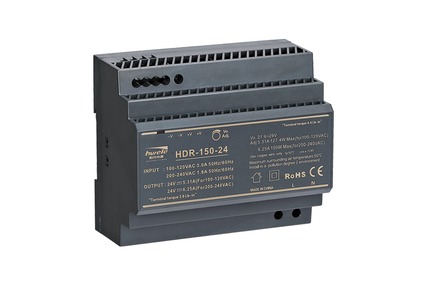
The most practical way to optimize industrial cabinet thermal layout is to source hardware built to minimize energy conversion waste from the start. Zhejiang Hengwei Technology (Hwele) engineers the premium DIN Rail Power Supply family across an ultra-reliable 10W to 480W spectrum, featuring advanced synchronized rectification topologies that achieve upward of 92% real-world efficiency.
By squeezing extra conversion performance out of every watt, Hwele hardware sharply limits ambient heat generation inside the cabinet footprint. Backed by an automated 6,000m² manufacturing infrastructure, high-temperature component selections, and comprehensive international safety credentials (CE, TUV, UL, ROHS), Hwele provides global systems integrators with a rock-solid foundation for continuous industrial uptime.

Stop allowing thermal stacking to compromise your automation networks. Partner with an established factory manufacturer capable of delivering slimline, high-efficiency, industrial-grade power topologies built for extreme environments.
Q1: What exactly is a power supply thermal derating curve?
A: It is a technical chart indicating how much maximum output wattage a power unit can safely deliver as the ambient environmental temperature increases. Past a specific target temperature (usually 50°C), output capacity decreases to prevent internal components from suffering permanent thermal damage.
Q2: Why do DIN rail power supplies require larger clearance spacing than standard enclosed frames?
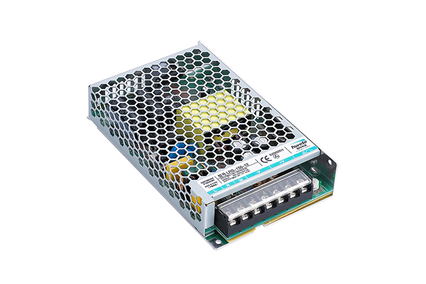
A: Unlike an Enclosed Power Supply that often integrates active forced-air cooling fans, DIN rail modules rely almost exclusively on passive, vertical air convection. Tight horizontal spacing blocks internal airflow paths, creating severe heat concentration loops.
Q3: How much power loss should I expect when operating past 50°C?
A: The vast majority of industrial power topologies exhibit a linear capacity loss of approximately 2.5% per degree Celsius ($^\circ\text{C}$) above their 100% capacity temperature rating limit.
Q4: Can I use an internal cabinet cooling fan to bypass derating limits?
A: Yes. Introducing active forced-air ventilation via cabinet fans lowers the localized ambient temperature back below the derating threshold, allowing the module to safely run at or near its full rated wattage.
Q5: What internal component inside a switching power supply degrades fastest from excessive heat?
A: Liquid electrolytic filtering capacitors are highly sensitive to high thermal zones. For every 10°C increase in internal core temperature, the operational lifetime of an electrolytic capacitor is cut in half.
Q6: Does a higher power supply efficiency rating help mitigate thermal stacking?
A: Absolutely. A power supply with 90% efficiency turns 10% of its intake current into pure waste heat. Upgrading to a 92% or 94% efficient module slashes internal heat generation by roughly 20% to 40%, keeping the entire enclosure cooler.
Q7: What is horizontal or flat mounting derating for DIN rail modules?
A: If a DIN rail power module is installed horizontally or flat on its back instead of its native vertical layout, it loses its chimney effect cooling. This typically forces an immediate 30% to 50% fixed capacity derating, even at normal room temperatures.
Q8: What is the difference between ambient air temperature and internal cabinet temperature?
A: Ambient air temperature refers to the external climate conditions surrounding the cabinet enclosure. Internal cabinet temperature represents the trapped, localized heat inside the box, which can easily be 15°C to 25°C hotter than the outside air due to operating equipment.
Q9: How do I know if my DIN rail power module has entered a thermal overload state?
A: Modern premium modules will either exhibit a red status fault LED indicator, drop their voltage output significantly, or enter a intermittent hiccup restart cycle to guard their delicate internal power semi-conductors from melting.
Q10: Are Hwele DIN rail power modules built to survive severe thermal settings?
A: Yes. Hwele integrates high-temperature rated solid capacitors, premium magnetic transformers, and thick aluminum heat-sinks, enabling robust operation across expansive industrial operating environments.


 Optimized by Seraphinite Accelerator